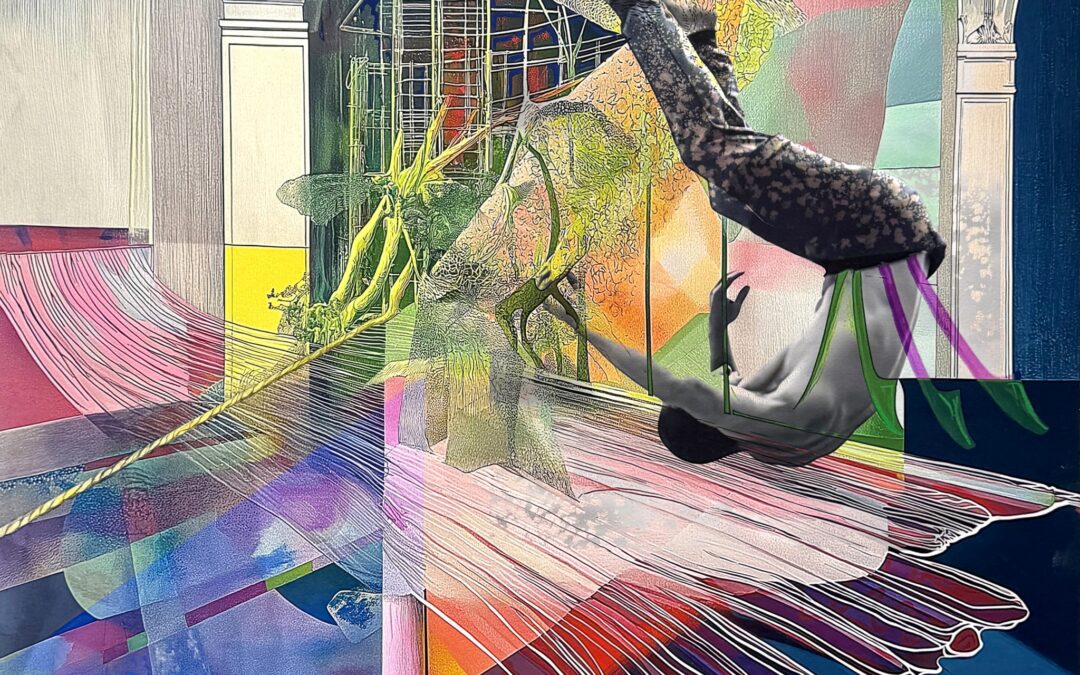
(Abol Bahadori, Prey, 2025.Pastel, watercolor, collage & pigment print on wood. Courtesy of the artist.)
By Betsy DiJulio
If you follow the local art scene, no one would blame you for thinking that Virginia MOCA is currently obsessed with vessels. And noteworthy vessels they are.
WHRO recently published my piece tracing parallels and divergences between Vivian Chou’s surprisingly elegant wood crate vessels in her solo show, “From Here,” and kelli rae adams’ ceramic rice bowl installation, “Forever in Your Debt,” in the concurrent 2026 Made in Virginia (MiA) juried exhibition. On the first day I visited, adams happened to be on site and graciously agreed to an impromptu interview. The resonances between the two bodies of work were undeniable. And featuring these two artists was a way to entice viewers to experience the dynamic shows for themselves because it is nigh on impossible to do justice to everyone in large group exhibitions.
Throughout, the work of 66 artists is generally large and feels perfectly scaled to the bright new MOCA galleries with their soaring ceilings. Most of the artists represented will likely be unfamiliar, even some based in Hampton Roads. Filling the galleries, with ample, breathable, white space in between, is sophisticated work that is fresh, unexpected, ambitious, and unfamiliar. It will make you proud to be a Virginian. But there is way too much of merit—like all of it—to include in a short review.
Still, I feel conflicted about choosing prize winners to spotlight because I am not fully on board with prizes, even when I have won them or awarded them. Not to take anything away from the jurors—all pedigreed professionals—or the artists who received well-deserved recognition, but one could make the case that the awarding of prizes in large mixed-media shows is an exercise in imposing an objective tiered structure onto what is inherently subjective. Comparing a delicate colored pencil drawing to an expressionist figurative painting to a minimalist conceptual sculpture is an apple to oranges conundrum.
When all jurors worth their salt are faced with this dilemma, they try to fairly discern qualities like intentionality, cohesion between idea and object, conceptual depth, original voice, innovation, risk-taking, lasting impact and the like, as they did here. And there are also other considerations, like spreading recognition across media. But still.
That said, please allow me to embrace the hierarchy and dig a little below the surface—although the surfaces are spectacular—of two of the top award-winners as but one portal into this dynamic exhibition of . The MiV jurors awarded The Good Prize to Ethan Brown for his stunning gourd painting, “This Council is a Box of Rocks,” which is not technically a vessel, but it is vessel shaped, and gourds were traditionally used as utilitarian containers, among other things, by the federally recognized Pamunkey Indian Tribe of which he is a member. MOCA executive director, Alison Byrne, awarded Elissa Armstrong the Director’s Prize for her large, exquisite earthenware vase, “Removal of the Lee Monument: a commemoration with magnolias and dogwoods.”
Artists have been adorning ceramic vessels with narrative images since the 3rd millennium BCE. Epic poetry, mythology, genre scenes, and historic battles have long taken their place alongside ritual, rulers, and court life from the Mayans to the ancient Greeks. Around the globe and throughout the ages, commemorative vases have been used as canvases for political propaganda and the marking of political appointments and treaties, life events of the elite, and imperial lineages. One might think there could be nothing new to say or ways to say it, but they would be wrong.
Armstrong and Brown commemorate events of markedly different natures. Armstrong’s body of work delights and titillates at the intersection of a range of influences from the aforementioned commemorative vessels to ceramic tabletop objects for the home, as well as traditional materials and processes juxtaposed and integrated with craft store supplies and mass-produced products like ceramic decals. After seeing her piece in MiV, it will likely come as no surprise that she is associate professor in the Department of Craft/Material Studies at Virginia Commonwealth University School of the Arts in Richmond.
In recent years, Richmond found itself at the epicenter of heated national controversies surrounding confederate statues. Do they stay or do they go? And if they go, where? In “Removal of the Lee Monument,” the last to be removed from Monument Avenue, Armstrong seems to be depicting the event and its context with all the paradox that the American South embodies, built as it is on layers of contradictions.
The large vessel is predominately white with a ruffled rim reminiscent of fabric. A closer look, however, reveals that the glossy white glaze is dripped over matte oranges and yellows with a brilliant blue dot pattern in a kind of whitewashing. The bronze statue of General Lee, with its undeniable alignment with segregation, racism, and “Lost Cause” mythology, was protested by Black residents and leaders from its erection in 1890. Here, image fragments of the statue alternate in narrow vertical bands with delicate drawings of magnolia and dogwood blooms, symbols of elegance, hospitality, and traditional Southern charm. Through these contradictory references, Armstrong creates a unified visual statement about complex discordances in Southern identity.
Brown has long resided on the Pamunkey Indian Reservation, located along the border of King William, Virginia, one of the two oldest reservations in the country. He moved to the reservation in his late teens and began making gourd art, following in his grandmother’s footsteps and selling his work in the reservation museum. Though he creates in a variety of other media—perhaps most notably film—an affinity for storytelling runs throughout.
Each gourd painting begins with a pencil sketch that he burns into the surface. With that framework established, he then works intuitively to carve away larger areas or paint and stain them in his rich earthy palette set off by vibrant color counterpoints. He combines stories from his community and other Native communities with myths and his mental archive of art, history, and culture more generally.
The narrative depicted on Brown’s award-winning gourd chronicles a tribal council meeting in which a participant tossed a box of rocks on the floor exclaiming, “This council is a box of rocks.” Brown skillfully merges a hierarchy of traditional and more contemporary interpretations of faces and figures with geometric patterns as he spirals the viewer around the vase in contrast to Armstrong’s more vertically oriented surface design.
Viewers can look forward to far more of Brown’s storytelling, as the generous Goode Prize comes with a $10,000 purse and a solo show concurrent with the 2028 MiV biennial.
2026 Made in Virginia
Through March 21
Virginia MOCA, Batten University Campus
VirginiaMOCA.org