
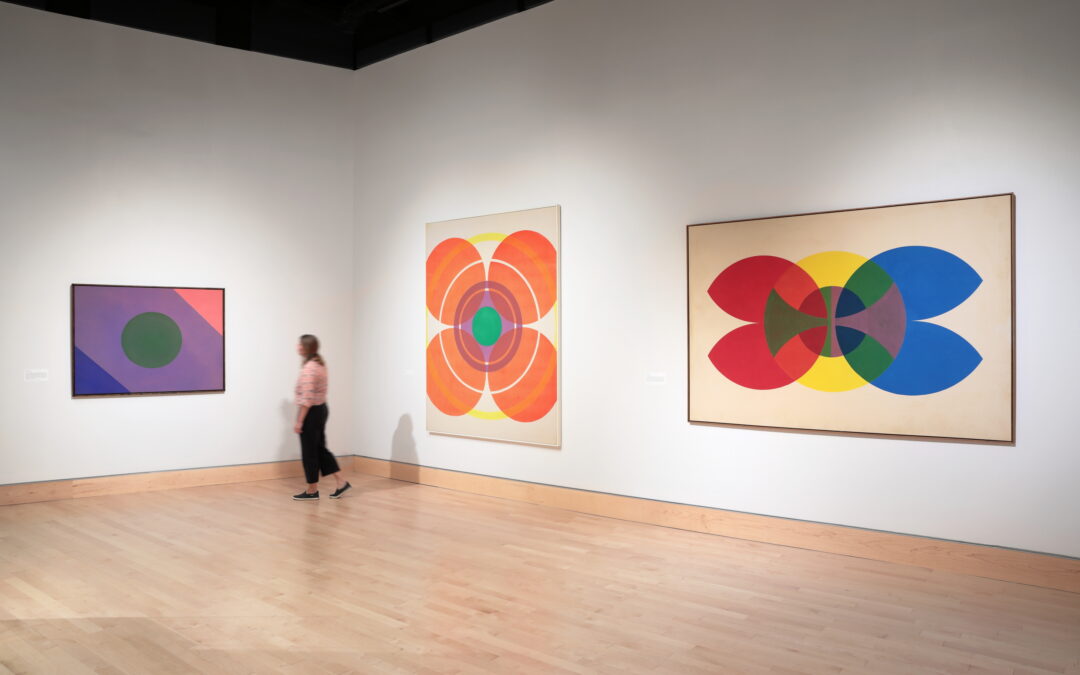
(Installation view of Paul Reed: A Retrospective. Photograph by David Hunter Hale)
By Betsy DiJulio
If our warring world is too much with you—combat wars, culture wars, information wars, science wars—Paul Reed: a Retrospective may be just the respite you need. Reed’s work is virtually devoid of social concerns, and his dazzling color and bold shapes are succulent and seductive, a physical reprieve from August’s scorching temperatures.
Reed (1919-2015) was a founding member of the Washington Color School, a group of loosely affiliated abstract painters and educators that flourished in D.C. in the 1960s. Their name likely came from the title of a 1965 exhibition at the erstwhile Washington Gallery of Modern Art. Entitled “Washington Color Painters” and curated by Gerald Nordland, the show introduced the work of this next generation of Abstract Expressionists.
Their deceptively simple compositions were the result of experimentations with color and paint application on an aggressively two-dimensional picture plane. However, some of Reed’s shaped canvases create a kind of forced architectural perspective with the illusion of dimension. These artists largely abandoned referential subject matter, yet still created dynamic and tension-filled works far from the social turmoil of that era. Embracing color field painting, hard edge painting, and both foreshadowing and overlapping minimalism, these artists poured, soaked, and stained paint onto canvas so that it did not sit on top of the surface as much as it became one with the surface.
Holly Koons, executive director of the Torggler, notes that Reed frequently used rollers to create his precisely geometric paintings, which often involve repetition and seriality of modular units. She appreciates that he “makes no effort to correct or remove the evidence of his hand.” The more time you spend with this artist’s work, she says, you realize he was not obsessed with precision, e.g. not afraid of bleeding paint. The latter, in fact, creates what she calls “moments of intersection” that generate new colors to which is added “subtle complexity and a generative quality.”
Reed has heretofore been less well-known than others in the group, such as Sam Gilliam, Mooris Louis, Kenneth Noland, and Alma Thomas. But this exhibition, organized by the Oklahoma City Museum of Art and curated by David Gariff, PhD, may serve to give this prodigious artist his due. Accompanied by a catalogue, rich with illustrations and scholarly articles, this retrospective brings together 122 pieces from Reed’s six decades of production, many of them freshly conserved for this exhibition, 11 years in the making.
The majority of works are from what Lucas Matheson, Torggler’s curator of exhibitions, describes as an incredibly fertile period from 1962-1972. Reed began painting seriously in his thirties and, at the height of his production, was making three works of art a day, resulting in the creation of some 3,000-5,000 pieces over the course of his life.
Unlike some of the other artists in the group, Reed did not have a single distinctive style. Rather, says Matheson, he is notable in part because his oeuvre is characterized by “such exceptional breadth and diversity and incredible range.” It is always changing and evolving through a succession of series.
Within each series, Matheson notes a “tight set of constraints.” What emerged seems to be the result of seeing how many permutations he could generate. “He proceeded like a kind of researcher,” appearing to ask himself how many possibilities were available to him within his sets of rules. Koons adds that Reed’s devotion to “his own personal exploration” and to his teaching career at the Corcoran School of Arts and Design superseded any investment in marketing. Hence, “his career remained a little quieter.”
Though the Washington Color School is primarily associated with painting, this exhibition provides a glimpse into Reed’s purposeful forays into a wide variety of media: collage, computer-generated and enhanced imagery, graphic design—he began his career as a graphic designer—photography, printmaking, and sculpture.
White text on Prussian blue wall sections serve as chronological wayfinders through Reed’s formative years (1919-1952), early career (1952-1961), mid-career (1962-1972), late career (1970s-2010), and legacy. Matheson explains that the installation, which dramatically reconfigures the Anne Noland Edwards Gallery into a unique viewing experience, is a result of leading with the work. “The work determines the location of the walls, not the other way around. We allowed the work to determine the nature of the space.”
Gariff’s personal relationship with the artist was crucial to the exhibition’s development. Additionally, in 1968 a trustee at the Washington Gallery of Modern Art, who was born and raised in Oklahoma, facilitated the sale of 154 out of 156 works from the closing Washington institution to what was then the Oklahoma Art Center. Subsequent gifts to the museum by Jean Reed Roberts of the artist’s work expanded its collection. While the vast majority of the work in this show hails from the museum, it also includes major loans from significant D.C. museums and private collections.
The show’s run at the Torggler is the result of Matheson’s relationship with Gariff, who was an important mentor and professor to him in undergraduate school. Gariff, a recently retired senior lecturer at the National Gallery of Art and adjunct professor of art history at the Catholic University of America, shared his work on the exhibition with Matheson, and asked if the Torggler would like to host the show. Matheson and Koons were on board. Given that Newport News neighbors the D.C. region, they felt it was important to expose their viewers to the Washington Color School, the only nationally recognized art movement to hail from our nation’s capital.
The Torggler is always free and open to the public, including for these upcoming events: Family Fun Day, September 19; Public Tour, September 26, 11 a.m.; and Torggler with a Twist, Thursday, October 1, 5-7 p.m.