
By Betsy DiJulio
I say, “Chinese decorative arts;” you say, “porcelain.” And you’re not wrong.
Blue and white porcelain and celadon, especially, are practically household names in the U.S. and are among the most successful global exports in history. Chinese porcelain went viral before viral was a thing.
Other materials central to Chinese decorative arts include carved stone, lacquer, and metal, according to Carrie Needell, Barry Curator of Glass at the Chrysler Museum. But, what about glass, she wondered.
That question led her into the depths of the Chrysler’s collection of some 10,000 pieces of glass accompanied by Clare Yee, the 2025 Woody Intern in Museum studies at William & Mary. Tales of hidden archival treasures brought into the light of public view dot the international museum landscape, but rarely in one’s own backyard.
However, working together, the pair did just that by digging into the museum’s permanent collection of glass—most of it collected by Walter P. Chrysler, Jr. during the 1960s-1980s—which leans heavily western. There they discovered only 80 pieces—that’s 8-0—from China (c. 1770-1970), with very few accompanying records. Simultaneously, they dove into the history of glassmaking in China, which was introduced there as early as the 5th century BCE.
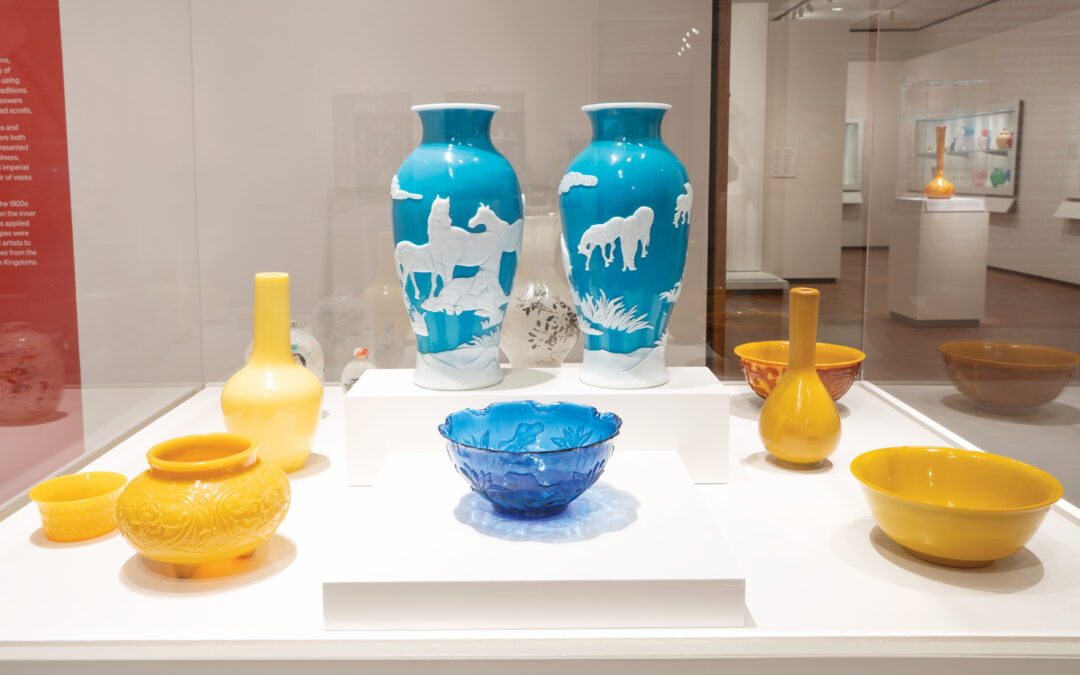
For this intimate exhibition in the changing glass gallery, they chose some 40 pieces that highlight color, methods, motifs, and history, including a handful of selections from the Hermitage Museum. “The color is insane,” says Needell. And, indeed, eye-popping hues are the first level of seduction. Coupled with their highly polished and glossy surfaces, no one will judge if you find yourself wanting to lick the glass.
Visitors are invited to read about these topics on vivid red panels. In the world of Chinese glass, this hue references gemstones like rubies and lacquerware, whose color was derived from cinnabar. Glass from the Qing dynasty (1644-1911) was brightly colored and meant to mimic the appearance and symbolism of other materials. Yellow, of which there are several mouthwatering shades in the show, was deeply symbolic, associated with the emperor and his court. As a result, it was highly collectible in the 19th and 20th centuries. Though monochromatic glass was the most common, multicolored pieces were made by overlaying a contrasting color of glass onto the vessel while hot. After cooling, the outer layer of glass would be cameo-carved or cut away to create a relief design.
Not surprisingly, the carved relief designs echo ornamentation on porcelain as well as furniture, textiles, and painted scrolls. Birds, dragons, horses, and flowering branches of trees and shrubs serve a decorative function, but they also symbolize a host of qualities: fruitfulness and longevity, harmony and honor, power and purity, strength and wealth. Landscapes and battle scenes were popular in “inside painting,” the practice of brush painting on the acid-roughened and “frosted” surface of clear glass. And symmetrical repeating patterns like the “hemp leaf design” relate to sacred geometry and Buddhism.
In short, the historical development, though complex, goes something like this: by the Han era (206-220 CE), Chinese glassmakers had mastered the art of casting in molds and by the 5th century CE, blown glass was on the scene. But it would be more than a thousand years until glassmaking enjoyed serious interest during the Qing Dynasty. Thereafter, it declined during part of the period of foreign intervention and subjugation known as the “Century of Humiliation” (1839-1949) before experiencing a revival at the turn of the 20th century.
Continuing in that thread is “Brood,” a wall-mounted installation of 1,022 cast glass, hand-polished cicadas by Chinese American artist, Helen Lee. Her work explores language and, as here, identity. The number is significant, for it represents 10 generations of her ancestry and, says Nedell, serves as a unique way of visualizing time.
The cicadas’ range of jade-like colors gradually transition as the swirl of insects converge at a point that is, in most installations, aligned with the height of Lee’s young daughter’s mouth. Not only is her daughter named Cicada, but the two of them enjoy folding origami cicadas together. In Chinese mythology, the Golden Cicada is believed to possess the power to grant immortality. Likewise, during the Han Dynasty, cicadas carved out of jade were placed on the tongues of deceased royalty and nobles to ensure rebirth and immortality. Hence, metaphorically, the piece looks both backward and forward.
Easily digestible, this show serves as a kind of visual amuse-bouche: a tiny treat to awaken your senses. Come for the color, stay for the content, and leave hungry for more.
WANT TO SEE?
Imperial Colors: Chinese Glass at the Chrysler Museum
Through September 13
Chrysler Museum of Art