
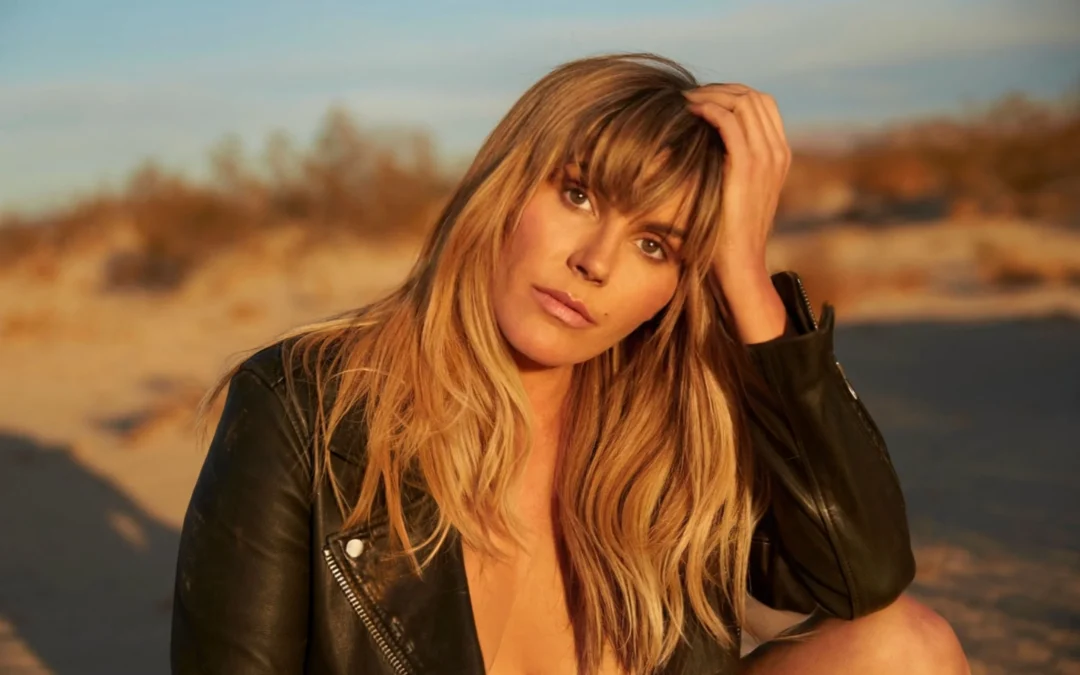
(Grace Potter will perform on the Lawn of the Museums of Colonial Williamsburg. Photo by James Mountford)
By Jim Morrison
Grace Potter is on the phone from her Topanga Canyon residence, but the restless rocker is about to head out on another cross-country road trip — her ninth.
The journeys started years back after she thought she had found a home in California. Why? “I was losing my fucking shit, is what was happening,” she says.
The first came after she and her husband, Eric Valentine, a co-writer and producer on her recent albums, suffered a home invasion during COVID. Nothing bad happened, but it shook her.
She flew east to check on her parents at their strange and wonderful sanctuary in Vermont (more on that later). ” I wanted to, you know, cozy up, and make sure everybody I loved and cared about was okay. And then the next thing I knew, we were signing papers on a fucking farm,” she says. “It was wild. It was such a deep cut into what I believed was going to be my happily ever after (in California), that it was real, it was really jarring for me.”
The road trips that followed helped forge her 2023 “Mother Road” album and her forthcoming “Trespasser.” In between, she took a different trip back in time, issuing “Medicine,” an album recorded with producer T-Bone Burnett two decades ago. Her record company refused to release it, sending her back into the studio to record thumping versions of the cuts, looking to turn her into the next arena rock star, not the next Bonnie Raitt. That resulted in her highest charting song, “Paris (Ooh La La).”
On those cross-country trips, Potter wasn’t alone. She brought with her the imaginary characters she created as a kid. They populate both “Mother Road” and a more mature, inner-looking “Trespasser,” where she took off the mask they provided and blended Grace with her imagination. The gas station music she recorded along the way inspired the sounds on those albums (more on that later).
“I really went back to a lot of the characters that I introduced during the album ‘Mother Road’,” she says of the new album. “I got to know some of these imaginary characters that I had made for myself when I was a kid…I found that these characters were really masks that I would put on to sort of give myself permission to wander into storytelling that felt a little dangerous for just Grace Potter, the person. So, I sort of create these masks or these characters that have deeper stories and have trauma and have wonder and have innocence or have like a complete disregard for the law.”
“Trespasser” takes the leap of admitting it’s all her. “I wanted to take those really fictional, outrageous characters, and the more grounded, realistic characters, and start to introduce them to one another until they all become the same truth, which is essentially the source material, aka me,” she says.
So, is putting on those masks a way to unlock her vulnerability?
“That’s exactly right. It’s like when somebody who’s been through trauma doesn’t want to go to therapy and crack the egg open and have it just ooze all over everything. There’s a safety in placing it somewhere outside of yourself, and I think that’s really where these characters all came from. I desperately wanted to understand some of the choices I made, some of the places I go, some of the reasons why I do the things I do, where I get attention and money and fame, and how that lands in a real person’s body, especially someone who grew up in a place like Vermont, where it’s not actually that cool to be famous.”
She cites two songs on the album where the mask is fully off — “Love Me Not,” the rocking first single, and “Belong,” the soulful album closer where she wonders why she hasn’t found a place she feels she belongs. “Maybe place is not so much my identity as it is how I feel and every place that I go,” she says. “These songs have been living inside me since ‘Mother Road,’ a lot of these had been unfinished business. There were some deeper stories, and some deeper sort of mining that I needed to do in order to get to a place where I was comfortable, especially with the last song.”
On “Love Me Not,” she opens by licking the wounds from someone who deserted her, feeling sorry for herself, but then looks into the mirror. “The true me comes out, which is that I don’t really care if you love me or not. There’s things I would love to fix about myself, but I can’t do it if this is a one-sided conversation, so I’m just gonna have a party over here,” she says. “I think that song is an active exploration or journal entry into my coping mechanisms, and then my most honest, unmasked self coming clean and admitting that. There’s probably nothing I can do about it, you know. I just am who I am.”
She will join the strongest Williamsburg Live lineup in years created by the Virginia Arts Festival on June 28, following Wynona and Melissa Etheridge, Trombone Shorty and Dumpstaphunk, and Alison Krauss and Union Station on the three preceding days On The Lawn of the Museums of Colonial Williamsburg.
Potter grew up in a long, strange trip of a household. Her older sister, Charlotte, is a glass artist who created the wild ruckus shows with bands and performance glass artists at The Chrysler Museum’s Perry Glass Studio before moving on to Old Dominion University’s Barry Art Museum and then departing for the Maryland Eastern Shore. Her brother is a poet with special needs.
“I think my parents would drop acid and read Tolkien at night, and then they’d call their friends, who were up on ski trips from Yale and MIT, these architect kiddos, and they would all just kind of build whatever,” she says, adding that she’s produced and provided the music for a documentary, Prickly Mountain, about the design build culture of the area. “It was really about the place, the nature, and acknowledging that there’s all these creative weirdos. We need a place to stay. It might as well look cool. So, our house really does look like an over-frosted birthday cake mushroom.”
Not surprisingly, they listened to every kind of music, something she credits for the wide range of her songwriting from rock to country to Americana to dance pop. Grace Potter and the Nocturnals, who played an unforgettable show at The Attucks Theater in 2008, started as a rootsy, bluesy rock band, but as a solo artist, she’s dipped into the divergent lanes of music.
“I don’t think about genre ever,” she says. “Even when I started the band with the Nocturnals, I remember it was almost like cosplay. I love music and my parents raised me on Celtic music, and barn burning weird disco, and Christopher Cross and Madonna, and Michael Jackson, and then UB40,” Potter says. “I just remember never really having any one lane I ever wanted to be in but having the band sort of come together over the cause of let’s make 70s rock and let’s bring back that good old rock and roll thing. It worked because it was so true to what we all loved.”
Over time, she realized she was more like a Bowie or one of the performance artists her sister would bring to the glass studio. “The medium of music is an incredibly flexible and malleable piece of clay, and I am one of those potters that loves to play with it,” she adds.
Being bi-coastal and making those drives with an open musical mind influenced her sound. “I do write differently in both places, and I tend to write about 50/50, but that’s not including the work I do on the road, where a lot of the ideas come from,” she says. “I would say that the seeds of all of these songs start in the Midwest, you know, the Bible Belt, and then I’m able to sort of crystallize lyrics.”
She’s a collector, a curator. “I also pull a lot from the places I go. I record all the time, no matter where I am. I record the music they play at the gas stations…I always try to go to the local gas station, because that’s where you’re really hearing the subconscious structure of a group of people who, at least in the humming and coming and going of that particular station, that’s sort of the pond that they swim in.”
“A lot of this record’s (“Trespasser)” guitar hooks, and especially with some of the pedal steel, a lot of the background vocals, a lot of the percussion, I’m literally mimicking and parroting some of the sounds that I captured from gas station playlists,” she adds.
Growing up in Vermont, her parents weren’t interested in fame. She was. Her first time on stage was at the Cabin Fever Follies in the Odd Fellows Hall in her little town, a long way from playing with Kenny Chesney, a friend, or The Rolling Stones.
“When music became something that was getting me attention, a lot of attention, it seemed like a really natural place to go,” she says.
It wasn’t easy and she wondered for years why she needed that.
“Having or feeling like I needed permission to do that was a huge part of my life, and I’m done with that, really over it,” she says. “I don’t need to ask forgiveness or permission. I would rather just have a place I can go to explore these things, and know that, yes, it is a part of me. And it’s dirty and ugly, and yet there’s this other very beautiful curiosity that comes from being willing to get ugly and go to those dark shadowy places, because what I come out with oftentimes is a much more well-rounded understanding and a much more honest understanding of probably where it all started to begin with.” — Jim Morrison