
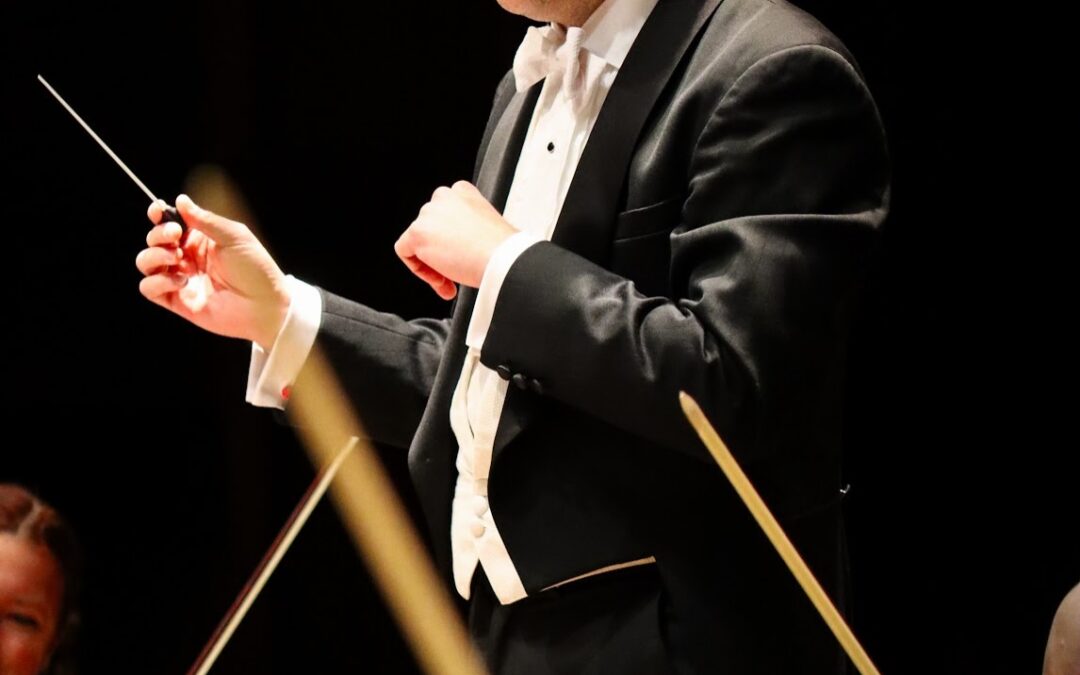
VSO Music Director and “Potsdam” director Eric Jacobsen. Photo courtesy of Virginia Symphony Orchestra.
By Montague Gammon III
Two classical musicians, Army enlisted men, helped the competent amateur pianist who was their Commander-in-Chief set the course of post World War II history.
The occasion was the Potsdam Conference of three world leaders, July 17–August 2, 1945.
“Finding Peace at Potsdam,” a unique new musical and theatrical look at how classical music became crucial at that momentous event, closes the Virginia Symphony Orchestra’s 106th season of classical concerts and continues VSO’s celebration of the our country’s 250th Anniversary.
Eric Jacobsen, VSO Music Director and “Potsdam” conductor said, “The music and the words are overlapping. There are some very poignant moments that are just words and some very poignant moments that are just music.” There’s a good bit of humor involved too, he acknowledged with a hearty chuckle.
President Harry Truman, Great Britain’s Prime Minister Winston Churchill and USSR Premier Joseph Stalin met in the Berlin suburb of Potsdam about 6 weeks after Germany had surrendered to finalize the European world order and demand the unconditional surrender of Japan. (If the results were imperfect, it could have been a lot worse.The colossal reparations the Soviets initially demanded of Germany would have created 1919 redux.)
Those men had little in common other than positions of power, plus, of course, being the winners.
Jacobsen spoke on the phone about the May 29-30 concert, especially about the Potsdam play-with-music that makes up its second part.
“I read the David McCullough [Pulitzer winning] biography of Truman and fell in love with this human as a character,” he began. “Truman [never having had real communication with FDR], all of a sudden, has to own this moment, go to Potsdam, and more or less set the course of the rest of the world…not only was Truman so spectacular at navigating these two lots-larger-than-life characters…but he used music” to connect with them.
“[Truman] felt at some point there was no way he could break through to Stalin and Churchill, so he wrote back to his wife, ‘Well, Churchill talks day in, day out and says absolutely nothing; I don’t understand him. Stalin just grunts but I understand everything he’s saying.’ ”
“He wanted to find a way to reach these people. As a beautiful amateur pianist and a music lover… he ended up flying in [two Army musicians], a sergeant and a private… from Paris and they played on the veranda of this house where they were having their conference.”
“Supposedly, when the pianist started playing a little Tchaikovsky [was] the only time that Stalin showed any emotion.”
Violinist Stuart Canin recounted, in a 2015 NPR interview: “Stalin leaped to his feet and said, ‘A toast to the musicians!,’ “ Jacobsen called that “sort of a changing point at Potsdam.”
“We’re going to more or less recreate the concert that was performed by these two wonderful musicians,” Jacobsen continued.
Those enlisted men, 27-year-old pianist Sgt. List and 19-year-old violinist Pvt. First Class Canin, played several concerts at the Conference, and came home to heroes’ welcomes. Both went on to long musical careers in prestigious positions. List played for President Truman several times and died in 1985 at 66; Canin turned 100 last April 5.
Truman turned pages for List when List was asked to play the Chopin Waltz in A-flat, Op. 42, a work he had not memorized. (That may have been the Chopin score that Truman brought from home.)
Both cities hosting “Finding Peace at Potsdam” have connections to the Conference. Truman took a train from DC to Norfolk, where he boarded the cruiser USS Augusta for Europe; Truman’s return voyage on the Augusta disembarked in Newport News.
Before the concert turns to Potsdam, VSO and the VSO Orchestra Chorus perform Aaron Copland’s “The Promise of Living” from “The Tender Land” and Bernstein’s “Make our Garden Grow” from “Candide.” These bracket Copland’s instrumental “Fanfare for the Common Man.” Jacobsen said all three, in music and in lyrics, “fit quite nicely” with the themes of Potsdam and America’s 250th.
For second half of the evenings, the play within the concert, Jacobsen mentioned Fritz Kreisler’s “Liebesleid for Violin and Piano”, “a Chopin,” and the Tchaikovsky B-Flat Minor Concerto. Another work from the Conference concert, which must have been especially meaningful to Truman, is vitally important to the play. That’s a minuet by Polish composer and pianist Jan Paderewski.
Jacobsen related how, when Truman was a child, his piano teacher took him to a Paderewski concert in Kansas City, and got him a backstage meeting with the celebrity musician.
There’s a recording, Jacobsen said, of the adult Truman saying “I was playing this piece and I was having trouble with it and when I was backstage Paderewski showed me how to make the turn.” The turn is “the moment in this piece that has a color change,” Jacobsen explained.
Jacobsen then added, “In this play ‘the turn’ becomes a metaphor. What is the next change? What’s ‘the turn’ of America? What’s ‘the turn’ of Europe? It comes back numerous times through the play, how it’s so hard to ‘make the turn,’ either make a decision how your life goes in a different direction or that you’re supposed to try to effect change….[There’s] this beautiful [moment] where he’s backstage after the concert and Paderewski actually puts his hands on Truman’s hands and shows him how to do it and that returns at the epicenter of the play.”
(Names of the three actors who play multiple roles had not been announced at press time.)
Jacobsen said the script, or “book:” “I talked to a couple of writers and I felt like Harley Elias is just perfect. He can take history and facts and make a beautiful moment. He just did such a spectacular job.”
We reached Elias by email in South Africa, where he is researching Ghandi for a new play.
His comments, excerpted:
“It’s an unparalleled opportunity to go far beyond a ‘Play with Music’ or a ‘Concert with Narration’ to a genre apart.
“From the brilliant mind of Eric Jacobsen, the mandate was to bring to life the music that Stalin, Churchill, and Truman listened to at Potsdam that provided a respite of shared humanity.
“At Potsdam they were…exhausted, improvising, insecure, ambitious, frightened, sometimes funny…it’s a rare chance to get to lose yourself in the music they heard and access a deeper emotional truth.
“From the beginning we wanted the music to be the heart of the storytelling, and for the actors to frame the stakes and context from which the music comes.
“We’d certainly be missing the Truman spirit if we made a piece that wasn’t accessible, direct, and understandable.”
“Finding Peace at Potsdam”
Virginia Symphony Orchestra and Virginia Symphony Orchestra Chorus
7:30 p.m., Fri., May 29, Chrysler Hall, Norfolk
7:30 p.m., Sat., May 30, Ferguson Center for the Arts, Newport News
Eric Jacobsen, conductor
Harley Elias, writer
Tanner Porter, arranger and orchestrator
Mikhaela Mahony, director
Special thanks to Wasserman Projects for commissioning the book.
Copland: “The Promise of Living” from The Tender Land
Copland: Fanfare for the Common Man
Bernstein: “Make our Garden Grow” from Candide
Various: Potsdam