
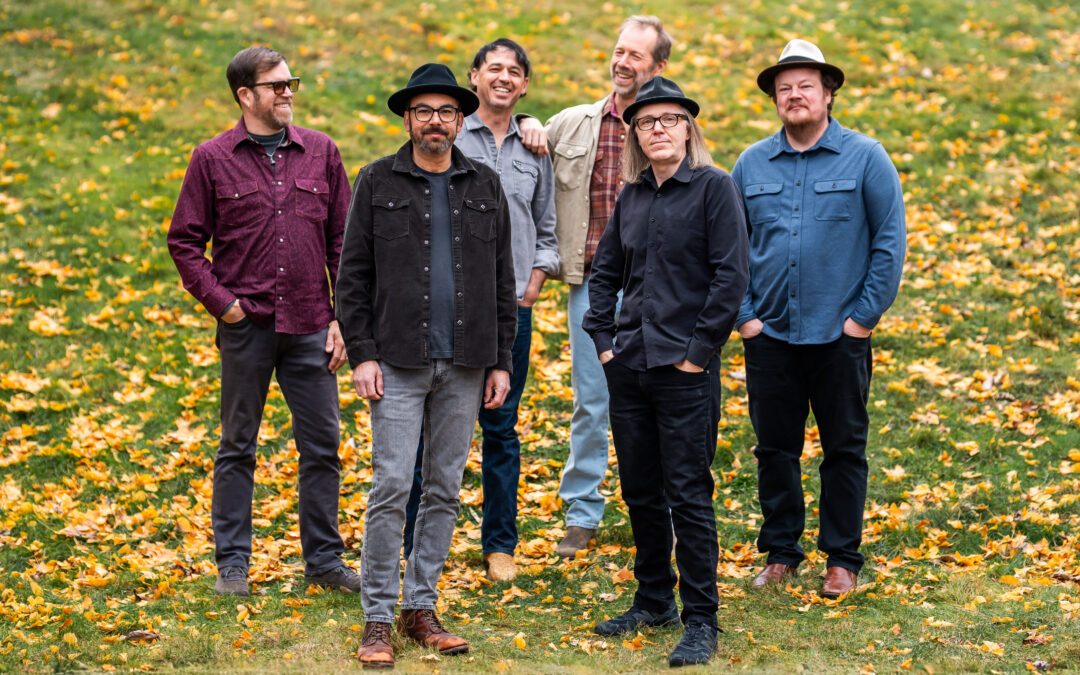
(Steep Canyon Rangers are outstanding in their field. Photo by Jay Strausser.)
By Jim Morrison
Barrett Smith joined Steep Canyon Rangers in 2017, nearly two decades after the band formed as a group of friends attending the University of North Carolina in Chapel Hill. But he’d been a part of their community from the beginning.
He’d been a student along with founding members Graham Sharp, Woody Platt, and Charles Humphrey III, who he replaced. “I was kind of a natural choice because while I’ve only been in the band that long, when the band started, I was right there, and we were all really close,” he says. “We’ve remained really close as friends, and also playing little side projects together all of those years.”
Smith studied classical guitar and has played Italian music for decades, but his skills extend to playing upright bass for the band.
After forays touching on Americana and jam band music — the members are Deadheads and they improvise live — their latest, “Next Act,” focuses on Steep Canyon returning to their bluegrass roots. “There might be a little bit of percussion here or there, ” he says. “There’s no drum set on the album, and there are no electric instruments on the album. It’s, for us, a real return to a string band ethos that we had kind of moved away from a little bit over the last few albums.”
The band plays the Virginia Arts Festival’s North Shore Point Downtown series in The Perry Pavilion on Thursday, May 14.
At times, the group has stretched the boundaries of bluegrass with drums and electric guitars. But Smith sees them as a bluegrass band at their core. Pop a head inside backstage before a show and it’s people playing Flatt and Scruggs, Bill Monroe and The Stanley Brothers.
Bluegrass means harmonies and trading lead vocals. And, over the years, Smith has blended in with the Grammy-winning band, where any of the members could take center stage. On “Next Act,” he sings lead on “Heart’s the Only Compass,” which features banjo by a guy named Steve Martin, who has championed the band bringing them along on his tours with Martin Short. Edie Brickell and Della Mae’s Celia Woodsmith, also contribute vocals on the disc, the band’s 15th.
Three band members sing lead vocals on the new album. That democratic take is part of making albums and arranging the songs.
Sharp or Aaron Burdett, another relatively new member, bring tunes to the band. “They take their song and release it into the Steep Canyon Rangers song machine,” Smith says. “From that point, the whole band is heavily engaged in arranging the songs. It takes a good bit on Aaron and Graham’s part of letting go. We all weigh in.”
A couple of albums ago, the band brought in songwriter, picker, and former Robert Plant band member Darrell Scott as a producer. “I remember him commenting in the middle of the recording process, looking around and saying, like, ‘What are y’all doing? I’ve never seen a band where every member has such strong engagement and opinions about each of the songs’.”
Any song may get passed around from singer to singer before the band finally lands on who will do the vocals. Smith likens it to The Band where Rick Danko, Levon Helm or any of the members might take the lead. “On the new album, I can think of at least one song that we were actually in the studio, and there were three different people who could have sang it,” Smith recalls. “Who ended up singing it, I can’t even remember right now…Our ideal situation is that we have such a strong idea of what the different characters in the band as lead singers are like, and what their strengths and just what kind of character they are, so that when any given song that comes around, it becomes a little more clear, like, ‘Oh yeah, you should definitely sing the song’.”
The band’s beginnings included renting a ramshackle cabin south of Asheville with no electricity and no indoor plumbing. More than 25 years later, members still live in and around Asheville. That proximity means some members see each other regularly, but not for music. Home time is downtime for kids and family.
“We all love hanging out with each other, but it’s kind of like we hang out so much on the road that when we’re home, it’s more like family time and just tapping into your own little community and ecosystem,” Smith says.
The road is where the music sings. “We really do all of our work on the road,” he explains. “We work when we’re on the road. Every soundcheck is a big rehearsal time for us. We’re hanging out all day together, and we’re like, well, we might as well be working. It doesn’t make any sense to hang out all day together on the road and then go home and schedule rehearsals.”
Their Carolina roots are showcased on every album. “Some places are just a little richer, you know, like, New Orleans is just richer. New York City is just richer. And the Mississippi Delta,” he says. “We’re from a place that is so rich that that helps us, being a North Carolina band. We’re really proud of it. We see ourselves as representatives, ambassadors, from North Carolina to these other places. We’re one of the bands. We’re a part of the story at this point.”
Working with Steve Martin and Edie Brickell has increased the band’s profile for years. When the band reached out to them about working on the new album, there was no hesitation. “They were both like, oh, yeah, sure, let’s do it. What do I need to do?” he says. “They just want to make art with us, which is hugely flattering.”
Martin recorded his banjo part in his New York apartment with Smith and Sharp Facetiming him, producing the session remotely. “And then Edie is such a magical, creative, mega artist, that we just sent it to her, and we’re like, you just do whatever you want, and then we’ll deal with whatever you do and figure it out,” he adds.
The group still backs Martin and Short regularly, although they occasionally ask for a few nights off to hit festivals — they’re playing MerleFest, Rocky Grass, and Kerrville this year. Della Mae, Allison Brown, and the bluegrass band of former member Woody Platt step in during those days.
The band has been around long enough to see bluegrass and string players and jam bands profiles rise and recede through “Oh, Brother, Where Art Thou?” to the latest Billy Strings mania, which Smith says eclipses previous highs.
“He’s really doing something that has not been done in the history of bluegrass music, as far as the crowds he’s drawing and then the enthusiasm and the adoption of a jam band like following that has only happened with like the Grateful Dead and Phish and Widespread Panic,” Smith says. “He has made that happen. And it’s so cool. It’s so cool to see it happen.”
And if some of those Strings fans dive into the genre and discover Steep Canyon Rangers, all the better. “I hope that some of those people who love Billy Strings so much as they research things that are like Billy Strings will come across The Steep Canyon Rangers and say, ‘Whoa. Who are these guys? They’ve been around forever. We’ll see if that actually happens. It’d be great if it did.”