
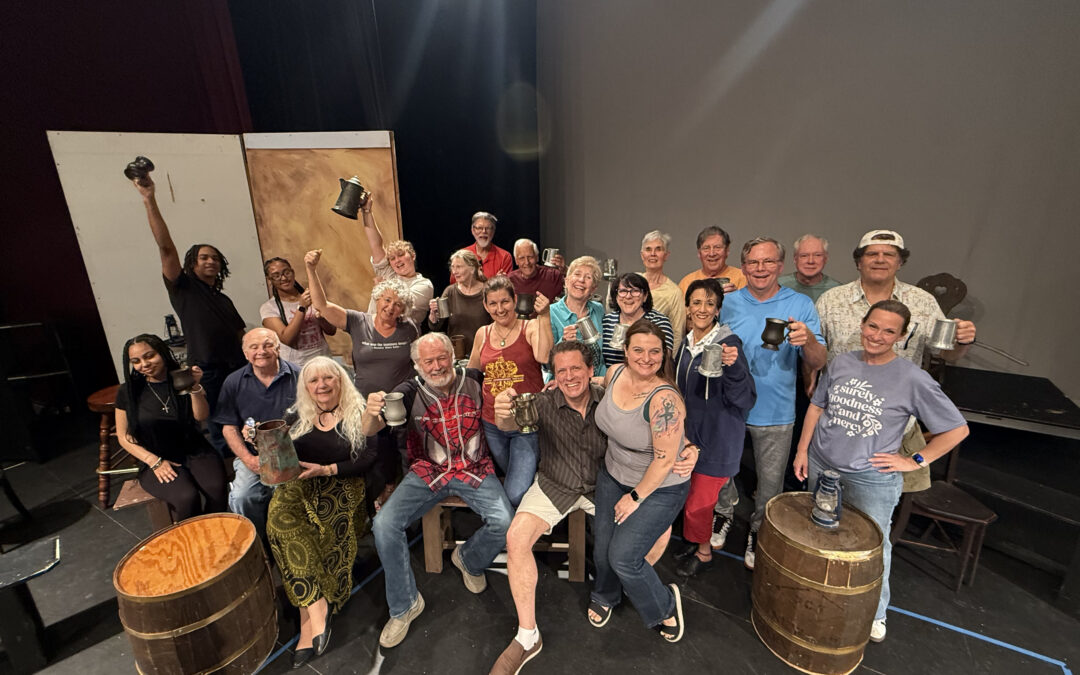
(Cast of Piece of Eden. Photo courtesy of Sheila Vera.)
By Sheila Vera
On Virginia’s Eastern Shore, history does not feel distant. Along this narrow stretch of land between the Chesapeake Bay and the Atlantic Ocean, many places carry Algonquian names like Nassawadox, Chincoteague, Machipongo, and Kiptopeake, each a memory of the people who came before. Dig a little deeper, and there are stories behind more familiar names, too: Savage Neck, Johnsontown.
This spring, Piece of Eden (1618–1776) returns to the stage at the Historic Palace Theatre in Cape Charles, telling stories of Eastern Shore history long before the birth of the United States. First performed in 2007 and revived in 2012 and 2013, the historical musical drama has been reimagined once again in 2026.
Written by local historian Jean Collins, with stage adaptation by Sheila Cardano and original music by Gwen Skeens, Piece of Eden traces the intersecting lives of Indigenous, African, and European people from the early 1600s through the American Revolution. It is a sweeping narrative rooted in specific lives: Debedeavon, the Accawmacke leader known as the “Laughing King”; Thomas Savage, an English interpreter moving between cultures; and Anthony and Mary Johnson, among the earliest documented free Black landowners in colonial America.
This latest revival is not simply a restaging, but a deeper telling of these stories, brought to life through live music, song, dance, and theatre. While the revision introduces new material, the characters and scenes from earlier versions remain, offering continuity for returning audiences.
“Piece of Eden touches that human nerve of belonging,” says director Clelia Cardano Sheppard, who founded Arts Enter in 1997 and has directed numerous full-scale musicals at the Historic Palace Theatre, with the collaboration of music director Megan Cartwright. “This revision centers the land as the holder of memory for three interwoven cultures.”
Native American cultural advisors Keith and Gail Fox, who were involved in earlier productions, returned to consult once again.
“We are grateful to have been asked to do this again,” says Gail Fox. “And we are grateful that everybody in the cast is so keen on making sure that everything related to Native American culture is as accurate as we can make it.”
This commitment to accuracy shaped key changes in the 2026 revision, including a new scene in Act III featuring a Native descendant. His presence affirms that despite generations of loss and displacement, the people of Accawmacke are still here. The role is played by Richard Press, an artist from Hampton who traces his family lineage back more than 400 years to the Native people on the Eastern Shore.
Press began researching his ancestry in the early 1980s and hasn’t stopped. “I wish I had been exposed as a young child to the history of Native Americans that has been here all along,” he says.
Choreographer Amy Watkins has created a dance for the revision featuring the Three Sisters, dancers embodying corn, beans, and squash. They symbolize the survival knowledge Native communities shared with early settlers.
Also new to the 2026 edition of Piece of Eden is the story of Anthony and Mary Johnson. Their rise as landowners, and the eventual loss of their land, reflects both the possibility of early colonial America and the tightening legal structures that followed. Before racial lines were codified into law, systems of labor and status were more fluid than they would later become. Both European and African people arrived in America as indentured servants, with the possibility, however limited, of building independent lives.
For cast member Damian Tyler Daniel, a second-grade teacher from Norfolk, stepping into this history has been deeply personal.
“As an African American man, learning about Anthony Johnson and his life has been an amazing journey,” he says. “To think about the challenges he faced and the decisions he had to make is powerful. My life has been impacted by the very steps he took, and now I walk on the same soil as he did. It is an honor, and it’s also enlightened me to parts of our history that don’t always make it into the books.”
Across disciplines, from museums to classrooms to community arts, there is a growing recognition that history is not singular. It is composed of many voices, some long amplified, others only now being heard, all witnessed by the land.
The connection to place runs deep within the cast of more than 50 performers drawn from the Eastern Shore and beyond. Cape Charles resident Sharon Whitman, who appears in both the tavern and Custis household scenes, claims a direct line to early English settlers and is now helping to tell her ancestors’ story.
“Some parts of the history most people are already familiar with. Others are stories that are not often told,” says Whitman.
Among the more widely recognized moments is the depiction of the Northampton Protest of 1652, one of the earliest documented protests against taxation without representation in colonial America, decades before the Revolution. Piece of Eden also brings to life the earliest documented English-language play in colonial America, Ye Bear and Ye Cubbe, performed at the Inn at Pungoteague in 1665. A lesser known moment is Mary Johnson’s bequeathment of property to her grandsons in 1672, an extraordinary achievement given the historical context.
As the narrative moves toward 1776, the formation of a new nation is framed as a continuation shaped by centuries of lived experience across cultures. The language of independence takes on new dimension when placed alongside the voices of those whose freedoms were uncertain.
Throughout the play, the land itself emerges as a constant. The narrator, played by Virginia Beach resident Tony Robinson, opens Piece of Eden with an invitation: “Surely you have heard
those voices echoing in the pines. And you will listen, because this is your story, and this land is your ‘Piece of Eden.’”
In 2026, amid ongoing conversations about history and identity, Piece of Eden does not attempt to offer a single conclusion. Instead, it opens space for many voices.
Driving through the backroads of the Shore, names like Debedeavon and Savage Neck begin to feel less like curiosities and more like echoes, reminders that these stories are still here, waiting to be heard.
WANT TO GO?
Piece of Eden (1618–1776)
April 24–26 and May 1–3
Historic Palace Theatre in Cape Charles
artsentercapecharles.org/pieceofeden, 757-331-4327.