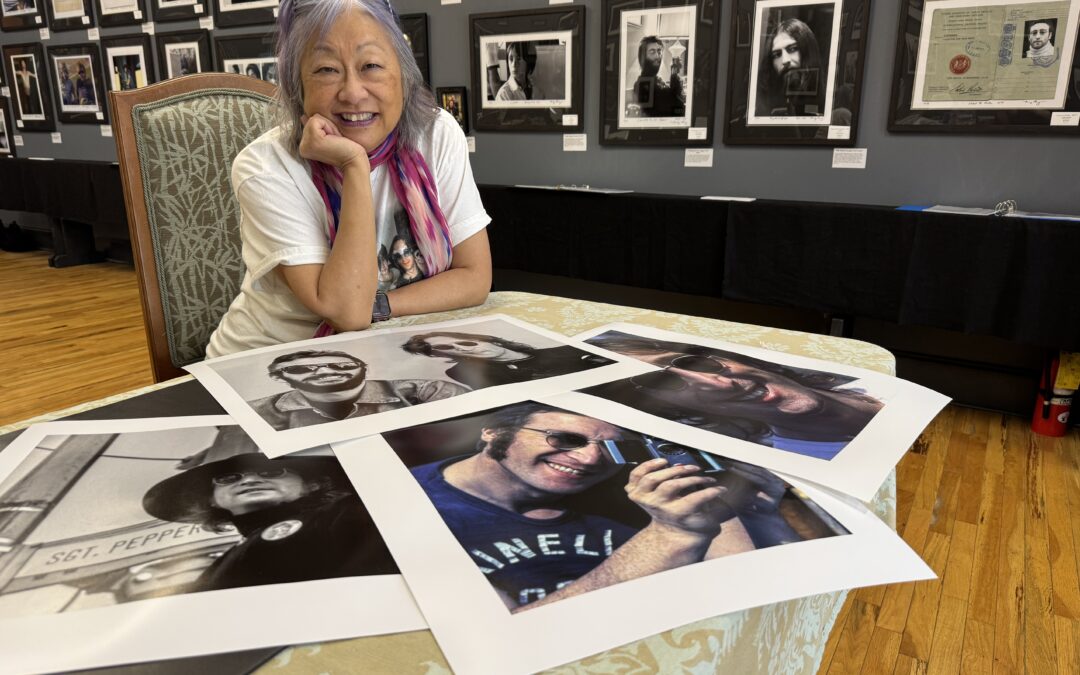
(May Pang surrounded by her photographs of John Lennon. Photo by Scott Segelbaum.)
By Jeff Maisey
Funny thing happened on the long and winding road just past Penny Lane en route to a Madison Square Garden concert appearance with Elton John— former Beatle John Lennon was having the time of his life for an 18 month period known as The Lost Weekend.
In a highly entertaining, well-produced documentary entitled “The Lost Weekend – A Love Story,” which debuted at the Tribeca Film Festival in 2022 and is available to view on Amazon Prime, we are treated to a fascinating and often humorous behind the scenes, firsthand account of the year-and-a-half relationship (1973-75) between Lennon and May Pang, his young assistant.
Many of the photographs featured in the storytelling film were taken by Pang, and a select 38 of the images will be exhibited for three days — April 24-26 — at the Stravitz Sculpture and Fine Art Gallery in Virginia Beach.
The unique photography exhibition will be hosted by May Pang herself. Pang will be onsite to meet with fans of John Lennon, sell framed photos, and sign those exclusively purchased at the gallery.
She asks enthusiastic Beatles fans not to bring memorabilia as she won’t be autographing their copy of “Rubber Soul” or that poster of Lennon giving the peace sign in front of the Statue of Liberty.
Before attending the art show, Pang also suggests fans watch the documentary to have a better context and connection with the photographs.
May Pang narrates the story from start to finish. It’s her story in her own words.
And as the story goes, we learn of a young, American-born girl whose parents were Chinese immigrants residing in New York City’s Spanish Harlem in the 1960s.
Pang grew up loving rock’n’roll music and like most girls her age was enthralled with the Fab 4.
She tells how she learned the Beatles’ record label — Apple — was headquartered in Manhattan, and then how she boldly applied and got a job working there.
“And suddenly, I was in the music business,” she exclaimed in the documentary.
It wasn’t long after answering phone calls and taking messages that May Pang became a favorite staffer in the eyes of John Lennon and his wife, Yoko Ono. Pang was promoted as their personal assistant.
Pang worked tirelessly and witnessed musical history in the making. Her duties included booking the studio musicians who played on Lennon’s “Mind Games” album. She was even in the studio for the recording and final production of the album.
It was during the mixing of “Mind Games” that marital tensions came to a head between John and Yoko. As the two discussed John taking time away, Pang said Yoko encouraged — in effect ordered — her to “date” John and accompany him.
May Pang and John Lennon flew out to Los Angeles for a weekend that became extended to say the least. Staying at the homes of business associates, the two were seemingly inseparable.
For the first time in Lennon’s life he was free of the Beatles and distanced from Yoko.
The documentary shows the long famous photos and film clips of Lennon and Pang hanging out at parties and the Troubadour club. Among John’s drinking buddies were Harry Nilsson, Keith Moon (The Who), Alice Cooper, Mickey Dolenz (The Monkees), Dr. John, and former bandmate Ringo Starr.
Lennon’s initial reason for going to The Troubadour wasn’t to party with friends. He wanted to see Anne Murray perform.
“He loved her vocals and we decided let’s go.”
The partying celebrities at the notorious venue did get noticed by the media. The paparazzi were not necessarily fair in Pang’s eyes when it came to alcohol consumption.
“Let me put it this way,” she said, “it is so exaggerated on John’s part. I really did take offense when they kept saying he was an alcoholic — he wasn’t. He went out with the boys, but we didn’t have liquor at home. We were lucky if we had a bottle of wine. The media like to make it more than it is.”
May Pang said she didn’t fully understand how under a microscope Lennon was until they started hanging out with friends in LA.
According to Pang, most of the Lost Weekend period was spent in New York City, not LA. Lennon and Pang rented a penthouse apartment in midtown. Famous musicians would often pop over for a visit.
“His friends used to come over all the time,” explained Pang, “and when I say that I mean one of our constant visitors was Mick Jagger. Paul and Linda (McCartney) were always over. We had Bowie and Elton. Everybody that was in town were welcomed.”
During this time, John and May were clearly viewed as a couple. May Pang was in love with John, and she truly believed he loved her.
May Pang is duly credited with bringing John and his son Julian closer together. The documentary tells of Yoko’s efforts to dissuade the father-and-son relationship, asking Pang to screen the calls and tell the young Julian his dad was not available.
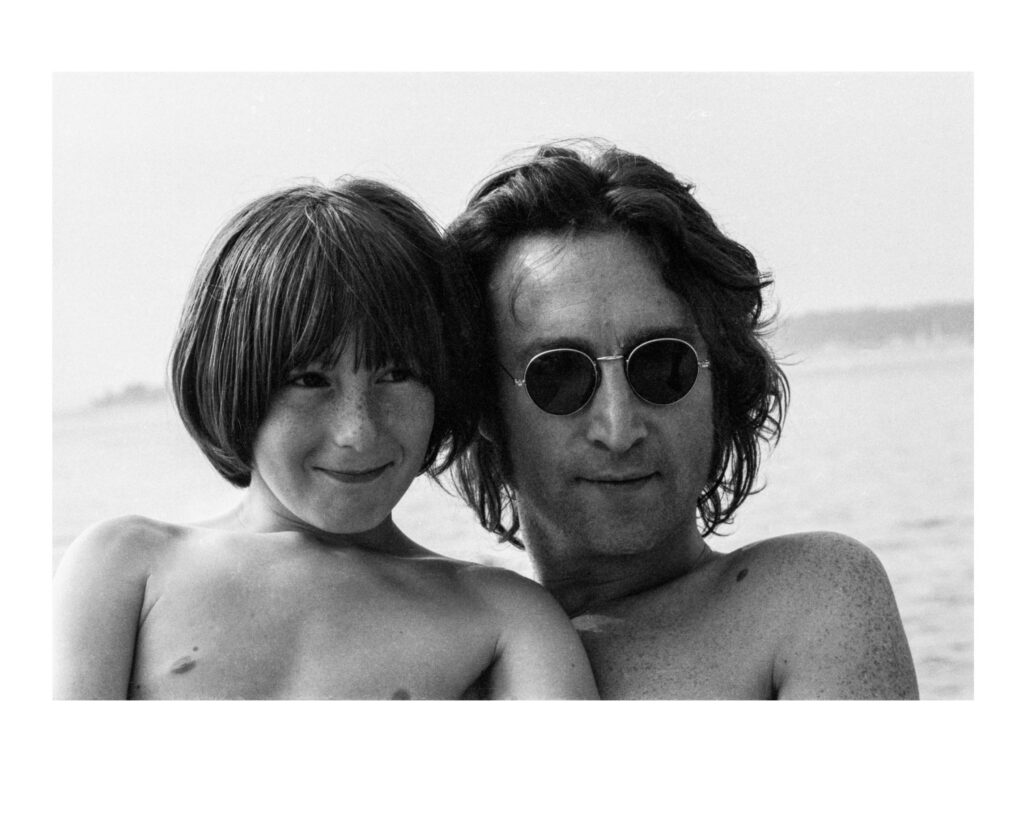
One of May Pang’s photographs in the exhibition is a black and white image titled “Father and Son.” (pictured above)
“We’re on a boat in the Long Island Sound,” Pang told me in a phone conversation. “I always felt he needed to see his father and his father needed to see his son.
“He (Julian) came to see us a few times, and during the summer it was great because we’d be on our neighbor’s boat,” said Pang. “They had kids the same age and they’d go swimming together.”
May Pang and Julian Lennon remain in touch — like family. There’s a touching scene in the documentary where Julian and May embrace in a recent moment.
“The last time I saw him was in New York a little over a year ago,” said Pang. “He was here on a book tour. We all had dinner together; it was fabulous.”
Two photos in the exhibition predate The Lost Weekend timeframe — both snapped in 1970 — one is a portrait of George Harrison and another of Lennon.
“If You Only Knew” (shown below) is another photo from the exhibition with a backstory. It’s a profile portrait of Lennon wearing a cap and smoking a cigarette.
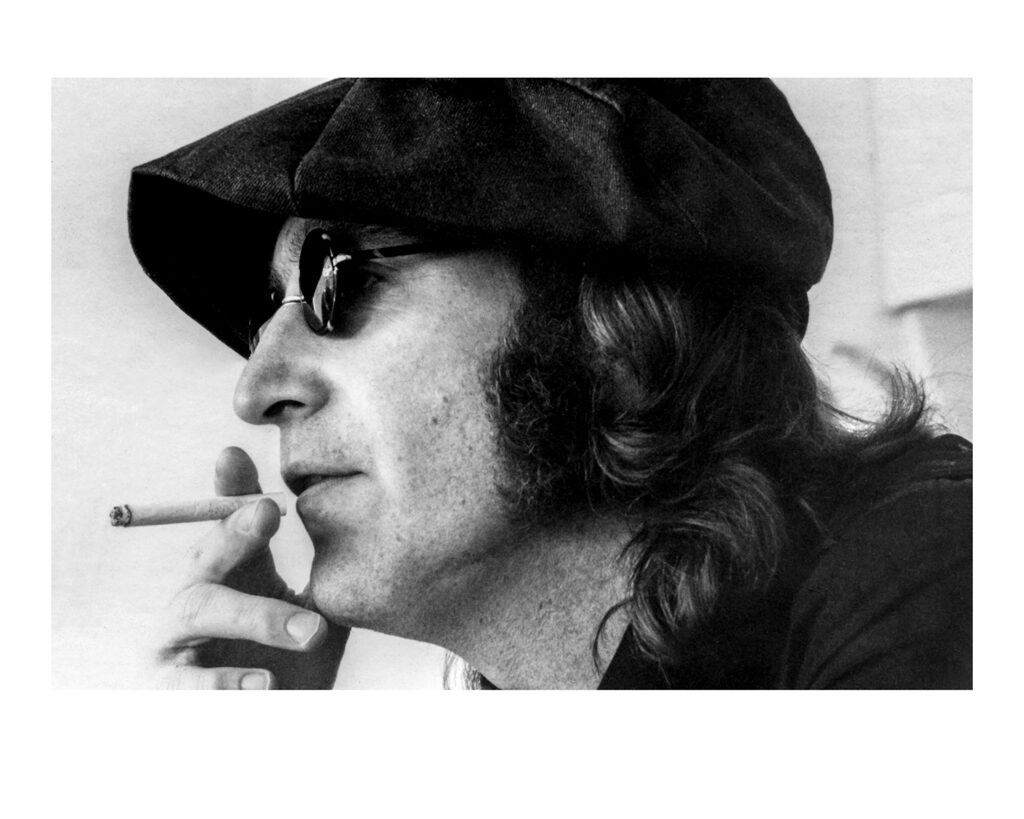
“It was at Disney World during the 1974 Christmas holiday,” said Pang. “It was right after John signed the dissolution papers (formerly closing The Beatles’ business partnership in Apple Records) and we were just relaxing at Disney World.”
During the Lost Weekend, John Lennon was itching to record music again. It was his most prolific period of his solo career.
In addition to working on Harry Nilsson’s 1974 album “Pussy Cats,” Lennon also contributed to David Bowie’s “Young Americans” album.
May and John were at a party given by Rat Pack actor/singer Dean Martin for his son Ricky. While talking with actress Elizabeth Taylor, May noticed a thin, very pale person walking in their direction.
As Pang explains, Elizabeth Taylor waves the man over and asks Lennon, “Have you met my friend David Bowie?”
Bowie would later ask Lennon to play on and help produce a version of The Beatles’ “Across The Universe” he was working on in the studio.
During a break, John Lennon was talking with Bowie guitarist Carlos Alomar about a riff he’d been working on. Lennon asked Bowie if he would come up with a lyric. The song turned into one of Bowie’s biggest hits at that time — “Fame” — with Lennon also adding guitar and backing vocals.
In 1974, John Lennon released “Walls and Bridges,” a solo album that ranked #1 on the Billboard album chart. The LP featured two hit singles: “#9 Dream” and “Whatever Gets You Through The Night.”
May Pang booked the core band of studio musicians and was present for the studio recording sessions and production.
“John was on such a high from the ‘Mind Games’ album,” said Pang. “He said, ‘I’m ready to do more.’”
On one evening, Pang arrived and John asked her to step in front of the microphone. Reluctant at first, she agreed to whisper his name “John” as heard on the mesmerizing hit “#9 Dream.”
Interestingly, many music fans believed it was Yoko Ono’s voice, but that was not the case.
While in the studio for “Walls and Bridges,” pop star Elton John came in to visit Lennon. He heard “Whatever Gets You Through the Night” and asked if Lennon would mind if he added some piano and vocals.
As the tale is told, Elton made a friendly bet with John that if the song reached #1 the two should join together on stage for a live performance of the tune.
Guess what happened?
“Whatever Gets You Through the Night” hit the top position of the Billboard, Record World, and Cashbox charts, making it Lennon’s only #1 song during his lifetime as a solo artist.
Making good on his end of the wager, John Lennon agreed to perform with Elton John on Thanksgiving 1974 at Madison Square Garden in New York City.
The documentary shows a nervous Lennon preparing to take the stage and an unexpected guest showing up for the performance — Yoko Ono.
About a month later, John and Yoko reconciled.
It’s a sad moment in the documentary where May Pang shares the story of John heading out to run some errands and saying the two would make plans for dinner later that evening.
Lennon did not return.
During my conversation with May Pang I asked what was John Lennon like as a person off camera.
“He had such a great sense of humor all around,” she shared. “He didn’t even know he was funny. He was just down to earth. He loved to watch television.
“He picked up the guitar whenever he felt like it. He had pieces of paper with notes all over it; lines he thought would be great for songs.”
Lennon was also curious about things and about people. While living on Lexington Avenue, Pang took Lennon on a city bus ride.
“He enjoyed it,” said Pang. “He got to see everyday people on the bus. We rode for a while before somebody finally realized who it was. He turned to me and said, ‘Time to get off.’”
Stravitz Sculpture & Fine Art Gallery, 1217 Laskin Rd., Virginia Beach, VA 23451, 757.305.9411