
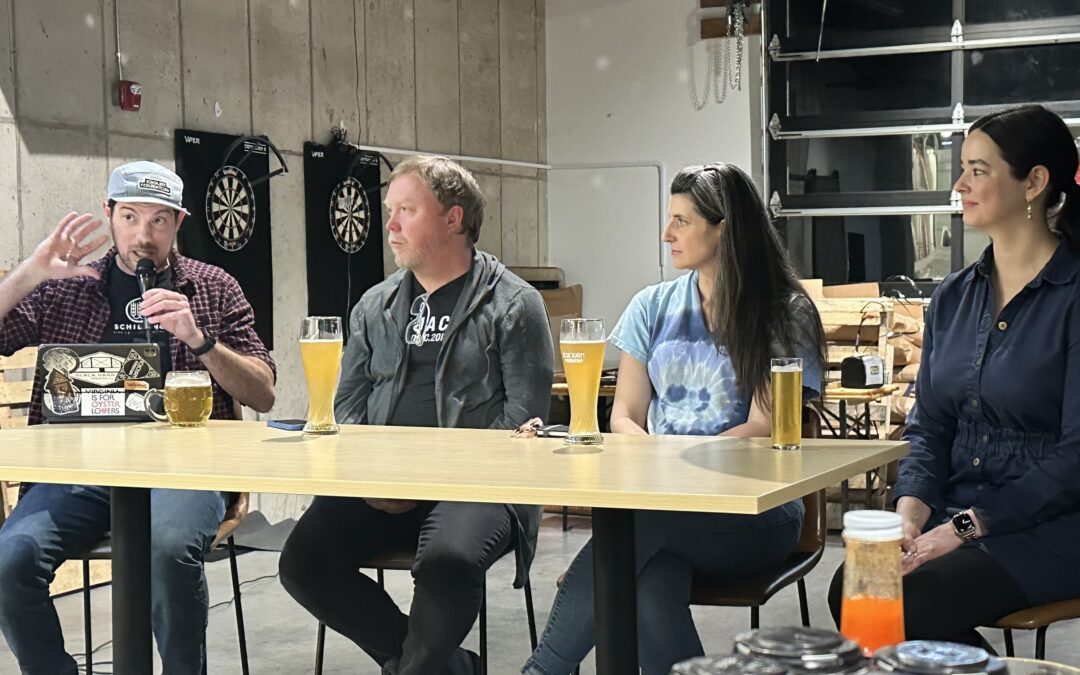
(Panelists at the Seat At The Table event at Sojourn Fermentory in Suffolk. Photo by Diane Catanzaro.)
By Diane Catanzaro and Chris Jones
One of the many things we love about the craft beer community is the camaraderie among those who work in the industry, bringing well-brewed beer of diverse styles and historical traditions to consumer of this liquid art. Suffolk’s Sojourn Fermentory, whose beers exemplify modern interpretations of traditional beer styles, recently hosted a panel discussion called “A Seat At The Table” featuring hospitality professionals from Hampton Roads and Northern Virginia.
The panel was introduced by Sojourn’s co-owner and operations director, Scott Osborne and moderated by Head Brewer and Production Director Josh Chapman. The panel consisted of Malia McGee, owner of the Birch Bar and Four Eleven York in Norfolk, Stefanie Osfolk, owner of the Bier Garden in Portsmouth, and Greg Engert, Beverage Director and Partner in the Neighborhood Restaurant Group (NRG) in Northern Virginia. NRG owns Bluejacket Brewery in Washington DC and several other noted beer establishments including Church Key, the Sovereign, and Rustico. The discussion was informative, lively, and fun, and lubricated by several outstanding beers brewed at Sojourn.
Josh’s initial discussion question for the panel was what is ‘most misunderstood’ by the general public when it comes to beer? Stefanie noted that most people think when you visit Germany you will find a great selection of German beers. German bars and restaurants tend to have a small selection of beers, typically a lager in the style historically brewed in that town or region. We agree, and have found the selection of German beers at Bier Garden is vastly more varied than you will find in Germany, with very few exceptions. Malia noted that the general public doesn’t understand the difference between ales and lagers. Someone will claim they prefer one over the other without realizing they may actually enjoy both.
Beer is just as agriculturally based as wine is, noted Josh. We think of wine as having ‘terroir’ but beer is also a product of the microclimate where the grain and hops are grown and the mineral composition of the water used in brewing. Malia chimed in that beer is much more complex than wine as beer has four key ingredients, malted grain, hops, yeast, and water, while wine has two, grape juice and yeast.
It is no secret that people are drinking less these days. This poses challenges for the alcohol beverage industry, especially craft breweries and the bars and restaurants that serve craft beer. Josh asked the panel where they see the craft beer industry five years from now.
Greg noted that beer offers lower ABVs (alcohol by volume) than other alcohol beverages, and that this where many consumers are heading. Also, he pointed out that craft breweries are finally offering more lower ABV beers instead of focusing on higher ABV styles that have been popular in the past.
Malia pointed out that people are realizing that not all beers need to be served in a 16-ounce pint. At the Birch all draft beers are offered in 4.5 ounce pours, and many in 10 or 12 ounce pours. She also noted that people are discovering the barrel-aged mixed fermentation styles that typically include wild yeast strains are so much better than the ‘kettle sours’ that have become ubiquitous at craft breweries. The future of beer may be less quantity, but high quality.
Stefanie asserted that the future of beer is trending toward ‘session’ brews, meaning lower ABV beers that the typical consumer can drink several of and not get inebriated, and that no-alcohol (NA) beers are ‘through the roof.’ She added that every bar and restaurant in Germany offers at least one NA beer, and today many traditional German and Belgian breweries are brewing NA beers. She also suggested that consumers are getting more interested in ‘beer flavored beers’ and that breweries should focus on making well-crafted drinkable beers that taste like beer, as opposed to brews like chocolate-raspberry sours. This raised a few eyebrows among those of us who think a chocolate-raspberry sour has possibilities. On the other hand, her key point is not lost. Every brewery should be able to brew solid traditional styles, like a Pilsner, Pale Ale, or Kolsch. These take skill to brew well and many customers just want an uncomplicated beer that tastes like beer.
One of the last questions Josh posed to the panel was why the folks on the panel chose to continue in the hospitality business, considering the low margins and long hours. Good question!
Greg stated that some of his best life experiences have involved eating and drinking. When he studied in Europe he discovered beer and the reward of turning people on to good beer back here in the States. Greg emphasized that he couldn’t imagine life without pleasures like beer and cheese. Now, he wants to prove beer is important and keep people coming to events at Bluejacket, Church Key, the Sovereign, Rustico, and other NRG businesses.
Malia mentioned that the energy of a Friday night when people come to your business was an honor and exciting, especially the proposals and wedding receptions that have happened at her establishments, The Birch Bar and Four Eleven York.
Stefanie exclaimed that the Bier Garden is a family business and her life, and she has been researching and learning about beer starting at age 20. She asserts that the Bier Garden is a huge part of who she is.
Josh added his own perspective, mentioning how beer and food was an important part of his family life growing up. He stated that breweries, restaurants, and bars create welcoming space where people of diverse backgrounds and viewpoints can come together. When we sit at a table together, things we disagree about seem to go away. If we can do that, Josh states, then love and hope win!
Also attending this event were Sojourn’s co-owner and beer entrepreneur Jinson Chan, Dave Delaplaine who is General Manager at Bluejacket, Tim Lieu who serves as Beer Director at NRG, and Ro Guenzel, Director of Brewing Operations at NRG. With so many beer industry people this was a great opportunity for Sojourn to pull out the stops and serve some truly fantastic beers. Josh opened a dark delicious Belgian-style quadruple dubbed Intellectual Hospitality that blew us away. Beers on the panel discussion tasting menu included a clean gentle Taiwanese-style rice lager called Gan Bei or ‘Dry Cup’, after the traditional Taiwanese toast. The Dreaming Smoked Bock, brewed as a collaboration with Denver’s renowned Bierstadt Lagerhaus was a smoky delight, as good as any of the rauchbiers we have had in numerous trips to Bamberg where they’ve had a several-hundred-year head start. The third beer on the tasting menu was a Double Mexican Radio-Mole Sweet Stout. Brewed with vanilla beans, cacao nibs, ancho chiles, and cinnamon, then aged in oak barrels for twenty-four weeks. This 11.5% ABV beer was so freaking good we’d go to Tijuana and munch on BBQ iguana for more. Fortunately, this and the other beers offered may be available much closer, at Sojourn’s Suffolk taproom, for a limited time. If not, you will surely find many great choices including their gorgeous Czech pilsners, Saison, Hefeweizen, and Kolsch.
At the end of the evening, Sojourn’s co-owner Jinson Chan treated the entire room to a very special experience. We each got a glass of Pappy Van Winkel bourbon chased by a glass of a tasty homemade pickle juice embellished with a pickle spear, to share in a delicious group toast of “Gan Bei.” A fitting end to a beautiful evening of beer community and cam-beer-aderie.