
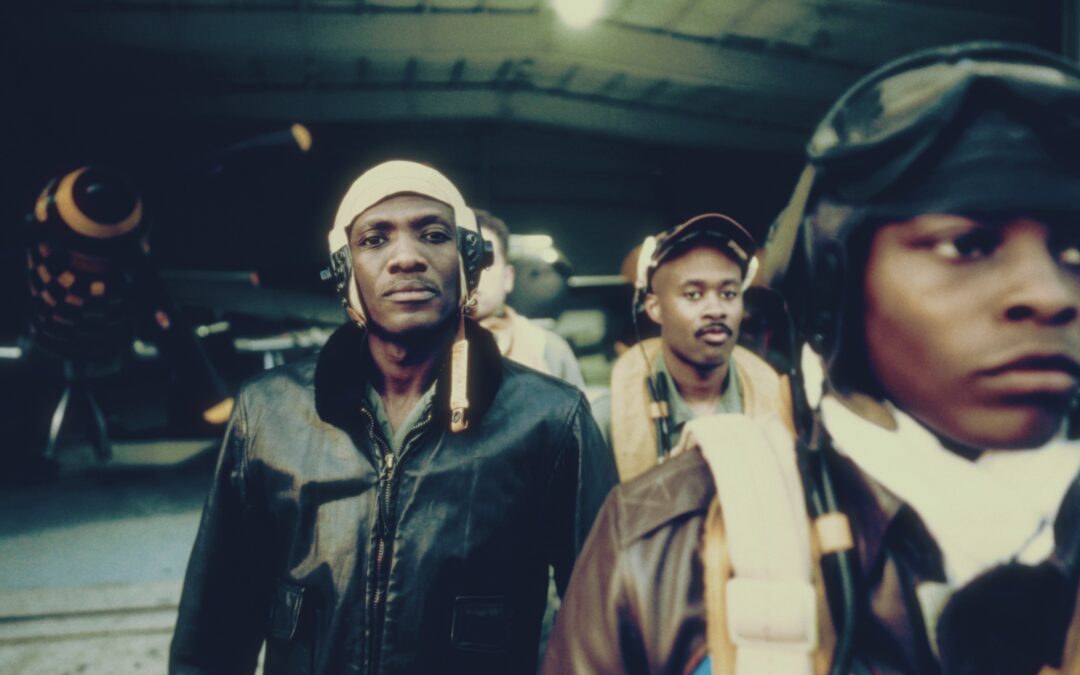
(Actors starring in “TUSKEGEE: An Immersive Experience” themselves experience a unique theatrical presentation. Photo courtesy of ROŪGE: Theater Reinvented.)
By Jeff Maisey
Theatrical stage sets use costuming, props, lighting, sound, and other tools of the trade to create an environment and backdrop to enhance the storytelling to unfold.
But what if the physical setting — the staging — wasn’t in a traditional theater? What are the possibilities?
What that looks like for locally-based ROŪGE: Theater Reinvented’s latest production, “TUSKEGEE: An Immersive Experience,” is the use of historic aircraft used during World War II in the hanger of the Military Aviation Museum to tell a unique, living-history-esque version of the trailblazing Black Americans who not only risked their lives to serve their country, but to break down barriers back home.
Written by local playwright Sherilynn Cherry, directed by Sharon Cook, choreographed by Broadway Veteran Deon Ridley, and featuring local theatrical legend Terrance Afer-Anderson in the role of LT. COL. Benjamin O. Davis, “Tuskegee” will indeed be an experience sure to garner post-performance discussions. .
To learn more about the premiere production, I gave Sharon Cook, whose long list of accomplishments as an actress and director also include her original works “Black Girl Magic” and “The Glory of Gospel: The Thomas Dorsey Story,” a call.
Following is part of our conversation.
VEER: Is “TUSKEGEE: An Immersive Experience” a retelling of a historical story most Americans are familiar with or is does the storyline expand the narrative?
Sharon Cook: The show is more than a story about airplanes and achievement. At it’s heart it’s about humanity, courage, brotherhood, and the right to dream.
The playwright want to just not tell the story of these heroic things the airmen did. She also wanted audiences to be able to see the humanity. To see what they were going through in terms of the brotherhood; the camaraderie between them; the fear that they faced; even with what they were dealing with back home in terms of racial segregation and Jim Crow.
They felt like maybe this would be an opportunity to show people that they were capable.
We’re more interested in the young men behind history — they’re fears, their families, their sacrifices and the bond that developed while they were fighting for their country and simultaneously fighting against the racism at home.
The characters are fictitious but they still tell the true story of what these men faced and what they went through.
VEER: In terms of background of the characters and dialog within the play did your team conduct research from diaries and interviews of real life Tuskegee airmen?
Sharon Cook: Yes, Sherilynn actually did a lot of research of these characters.
Even myself, as director, I would give my actors a real life Tuskegee airman that I thought their character really symbolized or emulated.
For example, one of my characters (Whit, played by Robert Torres) seems to embody the personality of real life airman airman Charles McGee. He’s very quiet but professional, and just wanted to do the job exceptionally well. McGee did 137 combat missions during World War II, and then went back later and flew in the Korean and Vietnam War.
Oh my god, how did these guys have that kind of tenacity?
Ultimately, he accumulated over 400 combat missions over three wars, and he returned to Tuskegee as an instructor.
So the actor finds that type of personality within as they’re developing that character.
There’s also airman Charles B. Hall. He was another powerful reference that I used.
He achieved the first aerial victory by an African-American in US history when he shot down a German fighter in 1943.
One of the characters feels this tremendous weight and pressure for wanting to succeed. That character in the play is Wood (played by Clifford Clark).
We do have Benjamin O. Davis, who was a Tuskegee airman as well, and he is portrayed in the show (my Terrance Afer-Anderson).
There’s also Lee Archer, who was a real life Tuskegee airman, that is portrayed in the show. He represents the fighter pilot who wants to be excellent not just because he’s Black, but as a young man he wants to be damned good at what he does. I feel like that’s who Junior (played by Jalen Lott) is — who is the lead storyteller in the play.
VEER: For this play, you have the unique opportunity to perform in an aircraft hanger with real World War II era planes as stage props. Since this is an immersive experience, how are the various set changes conducted?
Sharon Cook: There are some set pieces that come in and out, like bunkbeds and footlockers that represent their barracks.
We do get to play with some of the aircraft that’s in the museum, which makes this quite a interesting and a little bit challenging task.
The actors are excited to be within that space and energy being around large aircraft, and realizing that our smaller rehearsal space didn’t do justice for what that felt like for them.
VEER: How many acts are in the play?
Sharon Cook: There’s no intermission. It’s just one act. It’s a story with 11 scenes.
The runtime is no more than 90 minutes.
We have incorporated some music. One of our actors plays piano and guitar. There’s no band.
Another actor is a drummer.
VEER: How are lighting concepts being used to enhance the scenes?
Sharon Cook: We are using parachutes. We are doing some shadowy silhouettes behind the parachutes.
We can’t necessarily do spotlights, but we can create the effect of being in the air. This is a memory play as well so we create the effect of going back in time where they’re thinking back on a past memory.
Then there is the time when they’re narrating to the audience directly.
The lighting director is working out different washes she’s able to do to create those various scenes.
VEER: Are there many costume changes or are the actors mainly in jumpsuits?
Sharon Cook: Mainly the jumpsuits except at the end there is a change where everybody comes out in their fancy stuff (dress whites).
VEER: Do you use hazers or fog machines to replicate the sense of flying in the clouds?
Sharon Cook: Yeah, that’s gonna happen too.
I asked, Can we have some fog?
We can have fog. We also get to use the hanger doors. So we open those doors to reveal the men for the first time. And at the end there might be some attacking that happens.
VEER: What interactive elements allow the audience to engage?
Sharon Cook: Once they get to the museum outside in the lobby there’s going to be some exhibits the audience can participate in.
We want them to feel like they’re part of the whole recruiting experience, and then coming into the hanger that they are seeing things happening pre-show, like, I’m trying to change this propeller, can you pass me this tool?
They can participate in that way.
I wanted to create an experience where history breathes. That’s why I feel performing the work in an actual airplane hanger is so significant — the aircraft, the architecture, the scales, the echoes — all that becomes part of the storytelling and using magical realism, which the playwright is a big fan of; it’s part of her style.
Using those elements to move between the real world, the memory world, and the ancestry world is going to create that effect. I want history to feel alive.
Most importantly I want the audience to leave understanding that the Tuskegee Airmen didn’t simply overcome barriers for themselves, but they expanded what was possible for generations that came after them.
WANT TO GO
“TUSKEGEE: An Immersive Experience”
Presented by ROŪGE: Theater Reinvented
September 17—26
Military Aviation Museum