
By Tom Robotham
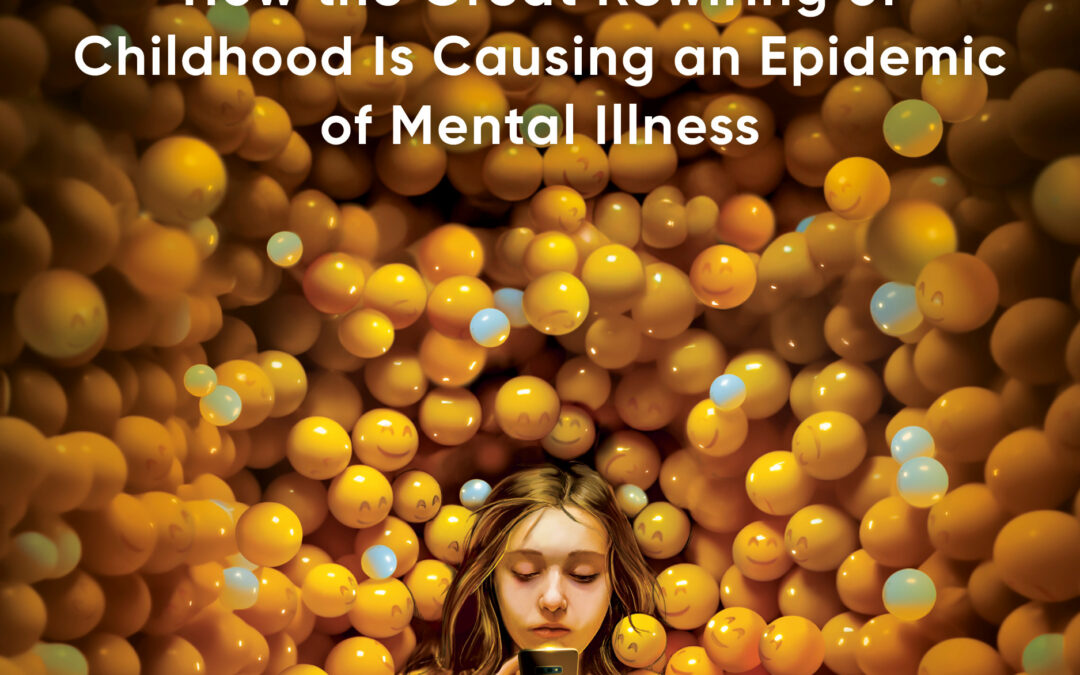
Recently I began reading The Anxious Generation, by social psychologist Jonathan Haidt—a book that explores the dramatic rise in mental illness among teens, beginning around 2010. He makes a compelling case that the chief cause is the proliferation of smart phones during that period. (The first iPhone was introduced in 2007.)
The book immediately got me thinking about the ways in which communication and media technologies have changed over the course of my life, and how these various developments have affected me, for better and for worse.
Perhaps the most important point to begin with is the fact that I’ve never known life without television. My older sister did for the first few years of her life, but by the time I came along in 1956 my parents had already bought their first set—and from the beginning, I was addicted to shows ranging from The Adventures of Superman to Leave it to Beaver. The addiction became especially acute during the summer I turned 10, when my best friend started hanging out with a different crowd: tough guys who shunned me. As a result, I spent even more time in front of our 19-inch black-and-white Philco, watching whatever was on. On Saturdays it was cartoons—Bugs Bunny, then Rocky and Bullwinkle—and after that a string of Westerns.
There was something comforting about being in the company of these virtual friends
who demanded nothing of me. Roy Rogers didn’t care whether I could fight or play football. He just invited me to tag along on his adventures.
That period of loneliness and isolation turned out to be short-lived. Before long I made new flesh-and-blood friends. But I never lost my love of TV. To this day, I can binge-watch a bunch of episodes of Friends and, for a while, feel as if I’m one of them.
In spite of this, I’ve often wondered what my life—and my brain—would be like had I grown up without television. In particular, would I be a better reader? As a child, I was drawn to watching rather than reading. For at least a couple of years, I hardly read at all, except for Mad magazine and what was required for school—and I often struggled with the latter. Had there been such a concept back then, I might well have been diagnosed with attention-deficit disorder. I’ve always been a slow reader, and I find it difficult to read for long stretches.
I can’t help wondering whether TV caused this, or at least aggravated it. And yet, the one thing that’s clear is that the tube never caused me anxiety. Even during the darkest of times—after JFK was shot, for example, when I was only 7—Walter Cronkite comforted me as I sensed my parents’ anxiety.
Back then, so did my record player and transistor radio. The latter was just a little larger than a smart phone—small enough to slip under my pillow at night so I could listen without disturbing anyone else. (It didn’t have headphones.)
The telephone—the only one in our household—played a much smaller role in my life. On occasion, I’d call friends, but for the most part, we just went out to find one another in the schoolyard or at other regular hangouts. And of course, had anyone tried to reach me when no one was home, I wouldn’t have known, since answering machines did not yet exist.
When I look at these technologies compared with today’s, another thing that comes to mind is the camera and various means for viewing, saving and sharing photos. Back then, I had a Kodak Instamatic but I rarely carried it, except on family vacations. I used it more in college, and I’m grateful for photos that I still have from that era, but when I think about this, several things occur to me.
One is that photos were much more special back then. After all, you had only a dozen or two exposures on a roll of film and had to wait a few days or a week to see them. Sharing them, meanwhile, was limited to in-person viewing, whether in a photo album or on a slide projector. Today, they’re instantly uploaded and out there for all the world to see—and judge or envy. Visual documentation of our lives is now both routine and ubiquitous, and I’m sure it has an especially strong emotional effect on teens, who measure their worth by the number of “likes” a particular selfie gets.
In short, with each passing generation, communication and media technologies have become more intrusive. For Baby Boomers, it was principally television. But while I’m certain that it eroded our attention spans, we couldn’t carry our Magnavoxes and RCAs to the schoolyard or the classroom for continuous viewing.
Nor could we carry our rotary phones wherever we went—and thank God for that. We had to interact face-to-face.
Gen-Xers and Millennials had more technology—early video games, for example, VCRs early cell phones and AOL chat rooms, depending on age. But for most people, these things remained peripheral through adolescence.
Gen-Z, by contrast, has never known life without “smart” phones and all that they involve: an endless stream of videos, memes and alerts, the culture of the selfie—which fuels a culture of narcissism— and “social” media, which is, to actual social interaction, what pornography is to sex.
I have no doubt that some people will write off my statements here as the rantings of an old man. If you’re among them, I urge you to read Haidt’s book. The evidence linking mental disturbance to today’s technology is strong.
Anecdotally, it also seems self-evident to me, as I watch my college students struggle emotionally. In a conversation with a friend recently—before I picked up Haidt’s book—I remarked that they seemed exceedingly fragile.
Fragile or anxious—take your pick. I myself feel both these days, inundated, as we all are, by daily outrages from the insane clown posse in Washington. For this reason, I’ve given up social media almost entirely and generally use my iPhone only for calls and short texts. I sometimes wonder why I don’t revert to a flip phone or even a landline.
I’m sure I could do it, having known, for most of my time here, life without these devices, which, in spite of certain conveniences, often strike me as absurd.
Alas, Gen-Z is stuck with them and is suffering the consequences. I shudder to think about the next cohort, Gen-Alpha, which will never know life without the daily smoke and mirrors of AI-generated “content.”
This, though, is one reason I continue to teach. These technologies aren’t going to go away. Our best hope is to try, at least, to raise awareness among young people of the damage that has already been done and the possibilities of mitigating their effects in the future.