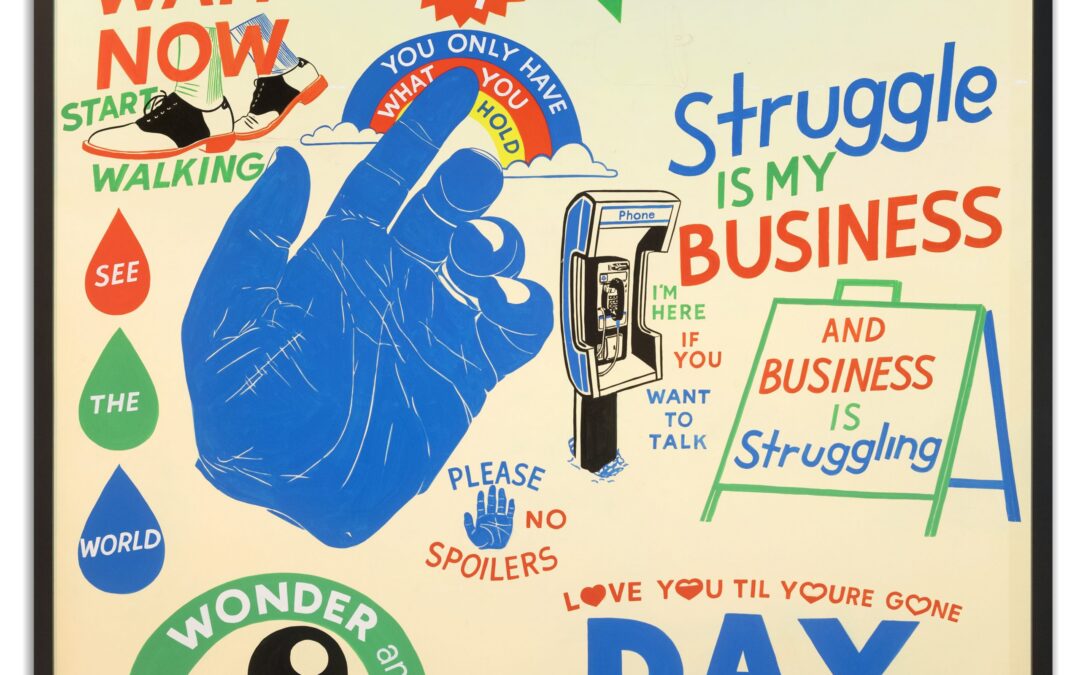
Steve “ESPO” Powers, Struggle is My Business. Enamel on aluminum. Courtesy of the artist.
By Betsy DiJulio
Seamless was conceived as a companion exhibition to Nina Chanel Abney: The American Dream, and it does so both visually and conceptually. The pieces in both exhibitions are vivid, energetic, and current while Abney and the 15 Seamless artists all blur the boundary between design and so-called fine art.
But, make no mistake, Seamless could easily stand on its own. Co-curated by MOCA senior curator, Heather Hakimzadeh, and Eric Wiggins, founder and co-owner of Thank You Gallery, the show’s energy feels as authentic as its origin.
On a recent tour of the show with Wiggins, he shared that his passion for these artists and their art dates from his teen years when he, a basketball player, and his friends—other b-ballers, skateboarders, surfers, hip hoppers, and punk rockers—discovered these artist-designers. Mere kids at the time, Wiggins et al began following them, and immersed themselves in their vision and aesthetic, a passion that persists.
The name of Wiggins’ gallery was spawned when he and his partners were hanging out, brainstorming ideas, and their eyes landed on a take-out bag. The graphics on the side read, “Thank You,” and suddenly their nascent gallery had a name. But that was then and this is now, a few years after MOCA first welcomed them into the museum to run a bookstore/giftshop and eventual gallery wall. The name has come to embody these young men’s gratitude for the many opportunities their association with the museum and the larger community has afforded.
Wiggins marvels at the way the show came together. These designers and artists move and work in overlapping circles which resulted in one of them enthusiastically accepting the invitation and recruiting another in an ever-expanding network. Says MOCA executive director of Wiggins, “…the Artists just adore him.” And that love fest sensibility is palpable.
When I shared with Byrne that Wiggins’ enthusiasm for the project was so magnetic and refreshing, not in the sense of a starstruck fanboy naïveté, but as a genuine soul connection, her response was, “100%.” She added that she thoroughly enjoyed working with him and getting to know him better through the process, saying, “I think he and Heather really brought unique and complementary ideas to the exhibition.”
So, who are some of these people who stoked a passion for design and visual culture in a young Wiggins and his crew? They are a group of creatives whose work has roots in graphic design, illustration, fashion, signage, street art, and zines. Some made new work for the exhibition; others shared existing pieces, from paintings to sneakers and skateboards, relief and 3-D sculptures, video animation, and beaded textiles.
Andy Howell, originally from Virginia Beach, grew up in the ’80s skating, surfing, building ramps, and drawing comics and cartoons, all set to a hip hop beat with a punk attitude. He turned pro skateboarder in 1989 and influenced the street skating world for the next decade and beyond. Socially and politically minded, he resists being labeled, which makes him an ideal contributor to the show. Perhaps best described as an artist and lifestyle and technology entrepreneur, he has made his home in Kitty Hawk, NC, since 2021 after traveling the globe as a pro-skateboarder and seasoned art director for a number of apparel and lifestyle brands. He now owns Ghost Ship Supply Co., an action lifestyle brand with all the online and in-person ‘fixins.
Shepard Fairey, who also arose from the skateboard scene, enjoys perhaps the most household name status of all the artists, courtesy his iconic Barack Obama “Hope” poster from the 2008 election. Based in Los Angeles and widely collected by the likes of the Smithsonian and the Museum of Modern Art, he may well be America’s best known street artist and activist. Founder of the OBEY project—a global street art campaign that holds power, propaganda, and consumerism up for critique—his Studio Number One agency has enjoyed collaborations with apparel brands like Nike and rock bands such as Led Zepplin. His warm-toned monochromatic power-and-glory diptych in Seamless is a master class in the intersection of boldness and subtlety with smoky layers of luscious, stenciled patterns and letters.
From Brooklyn comes multi-media artist and graphic designer, Shana Sadeghi-Ray. Her triptych of small, beaded textiles celebrates her Iranian heritage, especially the motifs and design logic of Persian rugs. Like other artists in the show, she has collaborated with major brands to celebrate the intersection of hand crafts and pop culture in pieces of deep personal and cultural meaning, some masquerading as pattern and decoration. Her Nike swoosh beaded key chains are one example. But her portfolio, spanning a client list that includes Footlocker, Calvin Klein, and Kate Spade, refuses easy categorization. Kitschy candy-colored animal figurines rub elbows with monochromatic botanicals and elegant typography, truly blurring boundaries in keeping with the spirit of Seamless.