By Betsy DiJulio
Virginia MOCA didn’t build a new museum. They built a new structure to house the museum they have been building all along.
This month, after some two-and-a-half years of planning, MOCA opens its doors to a sleek, 35,000 square foot, purpose-built facility on the campus of Virginia Wesleyan University (VWU). This new building has finally caught up to what had evolved over more than three decades at 2200 Parks Avenue in Virginia Beach, the institution’s home since 1989.
From a grassroots beginning in 1952 as the Virginia Beach Art Association, who launched the Boardwalk Art Show in 1956, the organization was renamed the Virginia Beach Center for the Arts (VBCA) in 1971 before becoming the Contemporary Art Center of Virginia (CAC) in 1996. In 2003, the center was expanded before being rebranded in 2010 as the Virginia Museum of Contemporary Art (MOCA), a non-collecting, accredited institution.
Located immediately adjacent to the Susan S. Goode Fine and Performing Arts Center at VWU, the two architecturally compatible buildings form the nucleus of an arts hub on the Avenue of the Arts, with the university’s studio class space and the Neil Britton Art Gallery nearby. The design of the new MOCA omits both an auditorium, as there is now one right next door, and a ceramics studio. The museum donated their ceramics equipment to VWU’s ceramics department and plans to share that facility.
The new lighter and brighter two-story museum is certainly beautiful, but so was the former building, albeit in very different ways. It is not so much that the new incarnation is more visually appealing—though, stylistically, the structures are miles apart—or that it boasts 20% more exhibition and education space, but that it lives so much larger. The staff had maximized every square inch in its former location, shoehorning both the popular ARTlab and the Community Gallery, along with a cramped security office, into the auditorium’s windowless backstage space and what amounted to a back hallway, with some classes frequently held on the stage.
As executive director Alison Byrne summarized, everything is “leveled up,” especially in terms of highly intentional and maximized functionality and flexibility. Take for example the “22 miles and counting” of cable that integrates audio, video, and communication technology throughout to support dynamic exhibitions and digital media, public programs and presentations, and hybrid meetings and collaborative work. Explaining that “We are a space that’s always changing, every day is different,” she recalls that weekly work sessions focused on simple things like “what’s next to what” and how to maximize use. If a piece of furniture can roll, a wall move, or a space divide, it does.
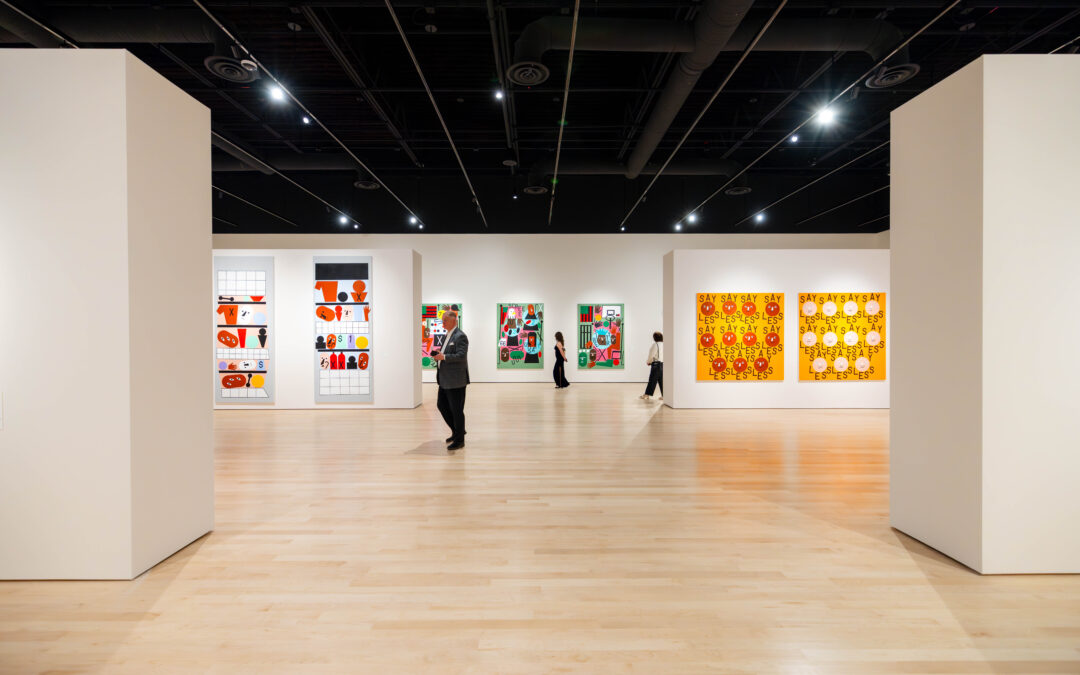
Upon entering the airy and welcoming public atrium and lobby, visitors are met with sunlight streaming through a massive 20’ glass curtain wall filtered by a perforated zinc veil and gleaming off terrazzo floors. ARTlab, the museum’s interactive gallery, has been expanded and brought out of the dark, situated just off the lobby in a spacious sun-drenched corner. A skylit corridor connects the lobby and ARTlab to a large, enclosed two-gallery core featuring blond maple floors and soaring black exposed ceilings. In keeping with their “Art Everywhere” tagline, the corridor, which is bookended by MOCA’s Mille Colori Dale Chihuly sculpture and an outdoor sculpture garden, provides an additional space for art activation.
But, in some ways, these public spaces are the tip of the iceberg. They are the visible and awe-inspiring aspects of the building. But they are supported by spaces that are just as impressive, though hidden from public view. The back of the house at Parks Avenue was woefully inadequate, but the staff made it work. At the VWU campus, ease and accessibility define the secure vault, art handling spaces, and clean room, complete with mezzanine storage accessible by lift and all the tools of the trade, not to mention the catering kitchen and thoughtfully designed security office adjacent to the loading dock and staff entrance.
Up the elevator—or an industrial stairwell, another space for future art activations—are staff offices built for how today’s workers prefer to do their jobs, both a large and small conference room, a library, and a wellness room plus a quartet of 1,000-square-foot studios. In the offices, walls of windows create a treehouse effect while a row of private spaces with glass walls and doors offer connection and accessibility.
What Byrne calls “touchdown zones” for impromptu meetings are supported by white boards that roll and attach to furniture. She describes a creative staff who loves to work together and who now have a space that supports however that might look like in all its varied forms. Low-walled cubicles in the center provide semi-private spaces for current employees with room to grow. The ample studios are outfitted with sinks, counters, storage, and rugged custom-built butcher block tables on casters. And instructors now have their own break room complete with lockers.
According to Byrne, morale has been “insane” with staff members already taking full advantage of the university’s library, gym, wooded trails, and dining hall while enjoying an “amazing” collaborative spirit within the VWU community. Now situated near the I264-64 interchange, MOCA is more easily accessible to people from far corners of Hampton Roads and beyond. All indications suggest that this partnership is a trifecta, with K-12 students and teachers, university audiences, and the broader community all holding winning tickets. Speaking of tickets, admission to MOCA remains free for Virginia residents.
Project Team & Partners • Architect: Tymoff+Moss Architects • General Contractor: Hourigan • Museum Planning: M. Goodwin Museum Planning • Structural Engineer: Speight Marshall & Francis • MEP Engineer: PACE Collaborative • Civil Engineer: TRC • Acoustics and audiovisual consultants; LSTN Consultants • Lighting Consultant: First Light / Lighting Virginia East • Landscape Architect: Core Studio Design • Signage and Wayfinding Design: LVCK, A Beyer Blinder Belle Studio • Commercial Furniture and Audiovisual Specialist: Creative
Virginia MOCA, 5811 Wesleyan Drive (on the campus of Virginia Wesleyan University), Virginia Beach, 757.425.0000, www.virginiamoca.org