
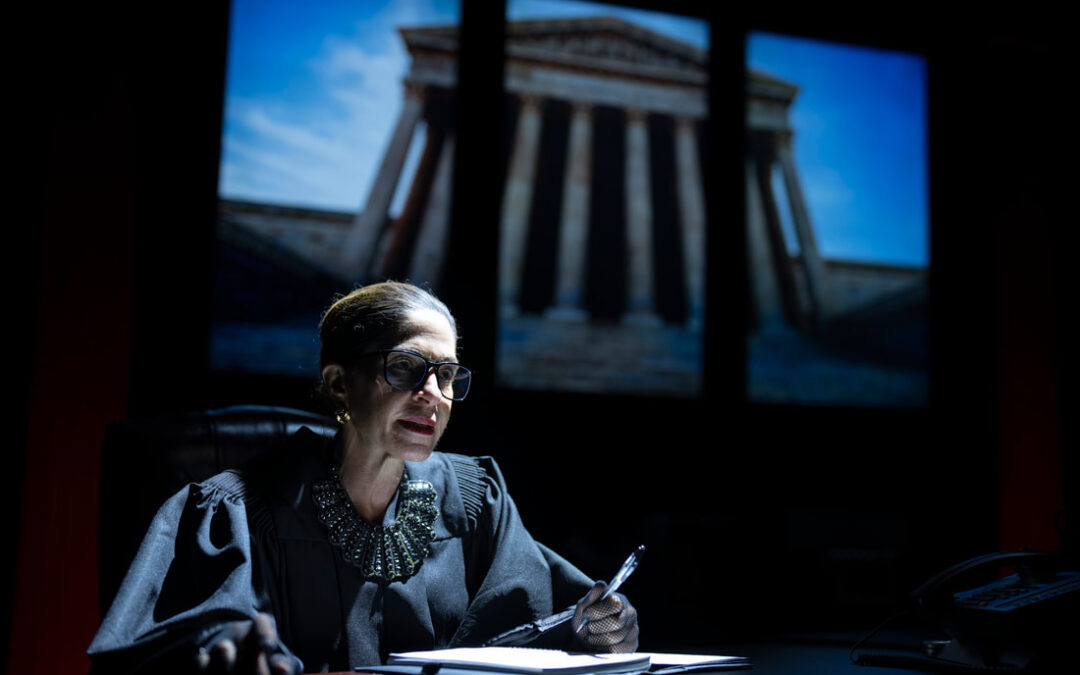
(Michelle Azar portrays Ruth Bader Ginsburg.)
By Montague Gammon III
The Virginia Arts Festival brings back to Hampton Roads, March 29, the most important play that anyone in local audiences will see this year, and perhaps for many years to come.
“All Things Equal – The Life and Times of Ruth Bader Ginsburg,” by Tony winner Rupert Holmes, returns to Norfolk’s Attucks Theater for a single performance some four years after it wowed the packed house of its first local performance.
The titular Supreme Court Associate Justice, visited in her office by an unseen high school friend of her granddaughter, relates the story of her life, and of the difficulties she faced seeking a legal education and career as a Jewish woman born in 1933.
Director Laley Lippard, a Virginia Beach native and Governors’ School alumna, has given this one woman monologue, superbly delivered by Michelle Azar, an impressive dynamism, entirely in keeping with Ginzburg’s character. Guiding the show adeptly, Lippard used finely tuned variations of pace and action that are convincingly natural.
That’s why “All Things Equal,” which Azar performs with unfailingly precise and unforced skill, easily and almost surreptitiously holds the attention of its audience throughout an entertaining, often funny, always fascinating, unbroken 90 minutes.
Actor Michelle Azar brings a personal link to Ginzburg’s story; their families evolved along roughly parallel lines from European Jewish immigrant stock. In a telephone chat, Azar quoted Ginsburg. ”Between a woman being born in the New York garment district or being a judge on the Supreme Court of the United States is one generation.”
The fruit of the Lippard and Azar collaboration is an impeccable theatrical event. In every facet of Azar’s diamond polished yet wholly natural performance, of hand and look and voice, of gesture and posture, in movement and in stillness, she gives a riveting yet seemingly effortless and relaxed portrayal of this genial, witty, razor sharp brilliant woman whose laser focussed articulation of her commitment to the true American dream of “liberty and justice for all” made her one of the most consequential persons of her time.
Ginsburg’s path to the Supreme Court was unimaginably arduous. When she was 14 months old, her 6 year old sister died of meningitis. The day before her high school graduation as valedictorian, her mother, who especially championed her daughter’s education, died. So she never delivered her valedictory address.
When Ginsburg was a 21-year-old mother of a newborn, and a Harvard Law student, her husband was diagnosed with cancer. She attended class and took notes for both, took care of him and their daughter, and typed his dictated papers. ( He died in 2010; she’d been on the Supreme Court for 17 years, and they had been married for 46.)
With the few other women in her Harvard Law School class, she was questioned by the Dean of the School: “Why are you at Harvard Law School, taking the place of a man?”
That Dean crops up repeatedly in this play. In karmic justice, he’s present at almost every step of Ginsburg’s rise to the top of the juridical profession. Repeatedly denied opportunities because of her gender, she persisted and prevailed over sexism and perhaps anti-Semitism.
(Harvard proudly mentions her time at the School whose statement of purpose was once ”To be the globally preeminent institution for the study of the law,” but must also acknowledge that she turned her back on Harvard and graduated from Columbia University’s Law School.)
Despite Ginsburg’s litany of unfair obstacles to advancement thrown up by the male dominated establishment, this is no somber nor preachy play, but one filled with plenty of humor and spritely joy. There’s often a twinkle in the eyes of Ginsburg/Azar as she tells her unseen visitor her life story.
The tremendous importance of All Things Equal, the viewing or at least the reading of which should be part of every high school American Studies/History curriculum, lies in its insights into American society as it existed and changed from 1933, when Ginsburg was born, until she died at 87 years and 6 months. She was responsible for no small part of that change and for our country’s progress toward that Pledge of Allegiance codified dream of liberty and justice for all. Today, five and a half years after cancer ended her struggles and her victories, the validity of the old cliché “What’s past is prologue” is being reasserted daily.
“We shall not see their like again,” exactly fits Ginsburg, but thanks to this production, audiences everywhere can get a good glimpse of what she was like.
Lippard terms directing this show from its very earliest incarnations, “One of the most significant artistic positions of my life,” and that life includes directing at the Kennedy Center, the Cleveland Playhouse, the Steppenwolf Theatre Company and our own Virginia Stage (“Grounded,” 2017) and ODU (“how I Learned to Drive,” 2018), and a host of other places around the globe, co-founding and co-executive producing the five year Chicago Home Theater Festival, teaching at Stanford, Northwestern, Carnegie-Mellon, Case Western and elsewhere, one film, and similar accomplishments that fill a tightly spaced page.
Azar has made a long career as an actor on stage in musicals and non-musical plays, on both the big and the small screens, and has written and performed in her own one person play about her family’s history, From Baghdad to Brooklyn. Her maternal grandmother not only educated herself out of New York’s garment district sweat shops to self-sufficiency, but at 18 joined the Folksbiene, the Yiddish theater in New York City.
Lippard sums up her thoughts on Ginsburg: “There is no better time than right now to have her words traveling across the country inspiring families and young people and people who might think that their time of political and collaborative efforts for justice might have passed. I can’t tell you the people who have left the show saying ‘She did that when she was in her 70s and 80s! I can do more.’”
WANT TO GO?
“All Things Equal – The Life and Times of Ruth Bader Ginsburg”
By Rupert Holmes
Presented by Virginia Arts Festival
March 29
Attucks Theater